reabc/Handbook for the Wrongfully Convicted pt2 - Eric D Smith Danachi/Handbook for the Wrongfully Convicted pt2 - Eric D Smith Danachi.pdf
Web PDF • Imposed PDF• Raw TXT (OCR)
![49 10. A copy of the appealed orders; ¥ 11. A word count certificate if necessary; and 12. A cetificate of service. See:e.g. Ind. Appellate Rule 46 A. Sometimes, depending on which appeals court has jurisdiction on over your appeal, your brief must also include a statement of jurisdiction. For examle, in Indiana, if you were sentenced to death or lifc imprisonment, the Indiana Supreme Court would have jurisdiction over your appeal pursuant to Ind. Appellate Rule 4. Your jurisdictional statement would therefore reflect this example, supported the clerk’s record, which you will make into On (date you were sentenced), appellant was sentenced to a term of (death or life imprisonment). As such, tis court has jurisdiction over this ‘appeal pursuant 1o Ind. Appellate Rule 4. This appeal is from a final judgment. and according tn Tnd. Post-Conviction Rule 1, Section 7, an appeal may be taken from a final judgment involving post-conviction proceedings, which is exactly what this appeal involves.” Check your state rules 1o see if you are required to include statement of Jurisdiction in your appellant’s brief. You should also get familiar with the appropriate standard of reviews for each of your issues and arguments. In Indiana, the general standard of review is as follows: “When appealing the denial of a post-conviction pettion, the appellant faces a rigorous standard of review. Atchley v. State, 730 N.E. 2d 758. 762 (Ind. Cs. App. 2000). Post-conviction relief is not a substitute for 2 direct appeal; rather, the post-conviction rules create a narrow remedy for subsequent collateral challenges to convictions. Martins v, State, 760 NE. 2d 597, 599 (Ind. 2002); Cowherd v. State, 791 N.E. 2d 833, 836 (ind. Ct. App. 2003), trans. Denied. The scope of the post-conviction remedy is limited 10 issues not known at the time of the original trial or that was unavailable on direct appeal. Craig v. State, 804 N.E. 24 170, 172 (ind. Ct. App. 2004). In a post-conviction proceeding, the peitioner has the burden o establish his claims for relief by the preponderance of the evidence. [nd, Post-Conviction Rule 1(5); Wesley v. State, 788 N.E. 2d 1247, 1250 (ind. 2003), reh’g denied; Hollins v. State, 790 N.E. 24 100, 105 (Ind. Ct. App. 2003), trans. denied. This burden for proving claims of ineffective assistance of counsel; however, is less than the preponderance of the evidence, for a petitioner need only show a ‘reasonable probability” that absent counsel’s errors the outcome of the proceeding would have been different. A reasonable probability is a probability sufficient to undermine: ‘confidence in the outcome of the proceeding. Williams v. Taylor, 529 US. 362, 4056, 120 . Ct. 1495 (2000) [citing Strickland v. Washingion, 466 U.S. 668, 694, 104 S. Ct. 2052 (1984)]. “A petitioner who has been denied post-conviction relicf appeals](Handbook for the Wrongfully Convicted pt2 - Eric D Smith Danachi 8.png)

![empty. Don’t put any of your pass case numbers n the box. When the United States District Court Clek receives your petition, he or she will puta totally ifferent and new number in the box. You’ll find out whatit s later. In the habeas proceeding, you’ll be known a5 the “petitioner” and the warden or head prison oficial of your prison will be known as the “respondent.” After you il these. boxes out, start answering the questions in the blank petition. ! ¥ 74 Eventally, you’ll come o a question asking you f you sought eview from the staie’s highest court. If you did, mask ys. 1f you didn*t, but tied to, mark no, but explain exactly why you didn’t .g., 1 wied 10, bt the prison officials woulda’t give me any legal and writing materias because they was realiating against me for my filed grievances. Then, I missed the state’s deadiins govemned by Ind. Appellate Rule 57 because of this. When I did et the needed materials, I tried o submit my issues to the highest cour, but they woulda’t accept it even though | told them why 1 missed the deadline; therefor, this action is a necessity. Heroare some grievances I filed about not getting any supplics, which | wmlean:rlfunllyguwmr.mdwmlmis:edmydmdlined*. See: Exhibit No. 1).” ‘The reason why the petition asks you this question is so the District Court knows whether your petition s bared by the Exhaustion and Procedural doctrine. In general, a federal court may only grant habeas corpus reicf 1o a state prisoner who has exhausted all stato romedies. See: 28 US.C. S 2254 (bY1XA) (2000). State remedies are not exhausted untila prisoner uilizes all procedures available under state law to raise s claims. See: 28 US.C. SS 2254 (c). Under the exhaustion requirement. the prisoner must present the substance of s claims to the stae court 1o allow those couts a fair “opportunity o apply controllng legal principls 10 the facts bearing upon its] constitutional claim ™ Picard v. Connor, 404 U.S. 270, 276-77 (1971). Becase of tis, this is why you must make such an explanation to District Courtin your petition; otherwise, it ‘will be dismissed pursuant to this doctrine right afler the court reviews it 1f you have to, e-wite the page 50 you can put your explanation in it. Puting such an explanation will prevail because there are ways to get out of the exhaustion and procedural default doctrines. Smhexp‘nflhfihmmyko{“flmnflml&f’ “Out of respect for finality, comity, and the orderly administration of justice, a federal court will not entertain a procedurally defaulted consiitutional claim in a pefition for habeas corpus (sic) absent a showing of case and prejudice to excuse the default” Drefke v, Haley, 124 S.CL 1847, 1349 (2004). The foderal courts may disperse with these docrines in other exceptions foo:](Handbook for the Wrongfully Convicted pt2 - Eric D Smith Danachi 18.png)
![evidence and alleged ineffecfive assistance during your state proceedings, but the state courts found counsel was ot ineffective, then you should 2.4 remind the District Court that determinations of counsel’s performance and prejudice are mixed questions of law and fact; therefore, the state court conclusions are not presumed to be correct. Strickland v. Washingion, 466 U.S. 668, 698 (1984). Remember, you have a constitutional right to present acomplete defense, see: e.g., Holmes v. South Carolina, 164 L. Ed. 2d 503, 509 (2006), and that counsel’s error and the evidence not beiny, beard denied you this right. A reasonable probability for a jury to find yosaox gilty is a probability that undermines confidence in the outcome ety proceeding. Strickland, 466 U.S. at 694. Because a Jury can only tixmyos, guilty beyond a reasonable doubt, this missing evidence provides such a probability and basis for a new trial or actual freedom. But remember, you sfill must argue and show that the state cour’s decision was “contrary 10, or involved an unreasonable application of” federal law clearly established by the Supreme Court [28 U.S.C. S.5. 2254 (d) (1) (2000)}. or “based on an unreasonable determination of the facts.” [28 U.S.C. S.5. 2254 (d) (2) (2000)). To argue that the state court’s factual determinations should nt be presumed correct requires that you show that they are erroneous by “clear and convincing evidence.” See: 28 U.S.C. S.5. 2254 (¢) (1) (2000). Presumptions ofcorrectness o ot appy (o fachal deerminatons it are not fairly supported by the record of your case. See: e.g., Meyers v. Gills, 142 F. 3d 664, 666 (3 Cir. (1998); Torres v. Prunty, 223 F. 3d 1103, 110 (9 Cir. 2000). 2 Ina habeas corpus proceeding you are not entitled to the appointment of counsel unless you have been given the death penalty (See: 21 USC.SS. $48 () (4) (B) (2000). Otherwise, the District Court can ‘2ppoint counsel when its necessary to utilize discovery [See: 28 US.C. S, 2254, Rule 6 (2)] or when the “interests of justice” so require. [See: 1 U.S.C. 5.5.3006 A (2) (2) (B) (2000)]. However, the District Courts i only appoint counsel in the “interests of justice™ when a prisoner is illterate or can not in any way prosecute the claims. Things to this nature, 50 basically if you’re competent and have access 1o legal materials, you won’t be appointed counsel in order 1o help prepare your petition for writ of habeas corpus or o file a reply 10 the state’s answer o your pefition. Nonetheless, You hare still constitutionally entitled to access 1o an adequate law library or the aid of persons trained in the law when preparing your petition. (See: Bounds v. Smith, 430 U.S. 817, 82128 (1977) (plurality opinion). If you’re proceeding in your habeas proceeding. as an indigent, you are also entitled 1o obtain needed documents or portions of the record without cost. See: 28 US.C. §.5. 2250 (2000). Once you file your petition, and the District Court does not dismiss the petition upon it initial review, the District Court will order the State to answer your petition. See; 28 US.C. S.S. 2254, Rule 4. Don’t expect victory because of this. Your head is only through the window. There is](Handbook for the Wrongfully Convicted pt2 - Eric D Smith Danachi 26.png)


Handbook
For the
Wrongfully
Convicted:
What do you do when the Judicial System fails you
and gives you the shaft?
By: Erlc D. Smith (Danachi)
Part Two
Chapter Nine
Through Twelve
With Resource List
(Two Zine Set)
Table of Contents
Book 2
Chapter Nine: My petition for post-conviction relief got denied. I'm scared.
What do 1 do’ page 3
Chapter Ten: My post-conviction relief was denied on the appeal. What
now?. page 11
205
Chapter Eleven: Habeas Corpus. What is it? How do I get started?
Chapter Twelve: Other ways of trying to get out of prison.
Resource List
About Eric D. Smith
(Danachi).
* Index and Table of Authorities ~ Available upon request
Much thanks goes to Ryan and the Buning River Collective for
transcribing this Handbook.
Published on March 18%, 2009 / @nticopyright / free (o prisoners
Formatted and Published by Anthony Rayson of the South Chicego
ABC Zine Distro, Donations appreciated.
Buming River ABC ‘South Chicago ABC Zine Distro
P.O. Box 602543 PO, Box 721
Cleveland, Ohio 44102 Homewood, IL 60430
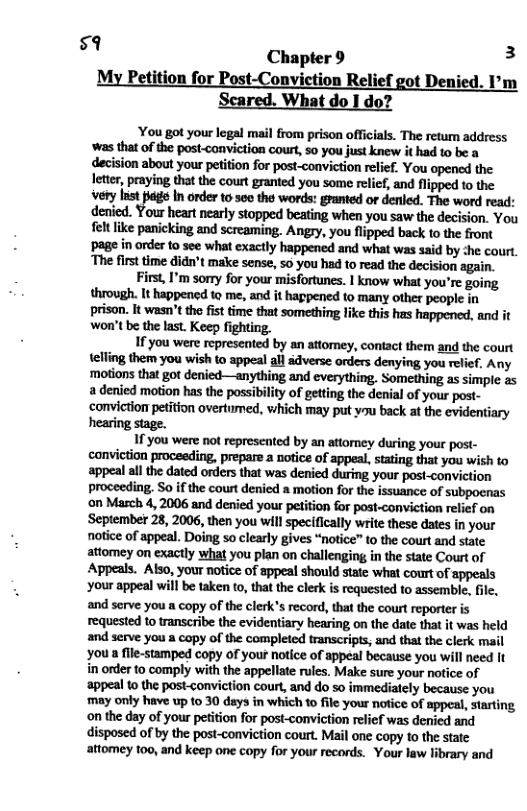
59 3
My P Relief got Denied. I'm
Scared. What do I do?
‘You got your legal mail from prison officials. The retum address
‘was that of the post-conviction court, 50 you just knew it had to be a
decision about your petition for post-conviction relief. You opened the
letter, praying that the court granted you some relief, and flipped to the
mhvwhmmmnm:mmm.mmm:
denied. Your heart nearly stopped beating when you saw the decision. You
feltlike panicking and screaming. Angry, you flipped back 1o the front
Page in order to see what exactly happened and what was said by zhe court
‘The first time didn't make sense, 50 you had to read the decision again.
First, I'm somy for your misfortunes. I know what you're going.
through. It happened to me, and it happened to many other people in
prison. it wasn’t the fist time that something like this has happened, and it
won't be the last. Keep fighting.
If you were represented by an attomey, contact them and the court
telling them you wish to appeal all adverse orders denying you relief. Any
'motions that got denied—anything and everything. Something as simple 2s
a denied motion has the possibility of getting the denial of your post-
‘conviction petition overtumed, which may put yu back at the evidentiary
hearing stage.
If you were not represented by an attomey during your post-
canviction proceeding, prepare a notice of appeal, stating that you wish to
appeal all the dated orders that was denied during your post-conviction
proceeding. So if the court denied a motion for the issuance of subpocnas
‘on March 4, 2006 and denied your petition for post-conviction relief on
‘September 28, 2006, then you will specifically write these dates in your
notice of appeal. Doing so clearly gives “notice” to the court and state
attomey on exactly what you plan on challenging in the state Court of
Appeals. Also, your notice of appeal should state what court of appeals
your appeal will be taken to, that the clerk is requested to assemble, file.
‘and serve you a copy of the clerk's record, that the court reporter is
requested to transcribe the cvidentiary hearing on the date that it was held
and serve you a copy of the completed transcripts, and that the clerk mail
you a file-stamped copy of your notice of appeal because you will need It
in order to comply with the appellate rules. Make sure your notice of
appeal to the post-conviction court, and do so immediately because you
‘may only have up 1o 30 days in which o file your notice of appeal, starting
‘on the day of your petition for post-conviction relief was denied and
disposed of by the post-conviction court. Mail one copy to the state:
attomey 100, and keep one copy for your records. Your law library and
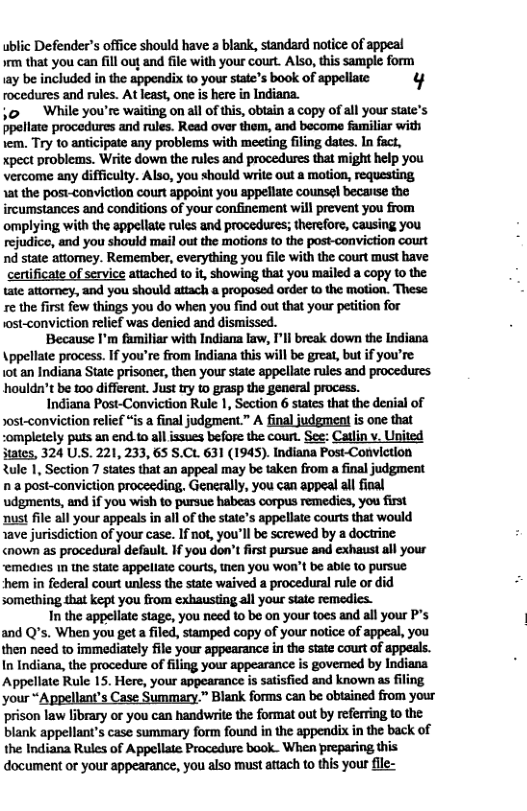
ublic Defender’s office should have a blank, standard notice of appeal
»m that you can fll out and file with your court. Also, this sample form
1ay be included in the appendix (o your state's book of appellate [
rocedures and rules. At least, one is here in Indiana.
;0 While you're waiting on all of this, obtain a copy of all your state's
ppellate procedures and rules. Read over them, and become familiar with
tem. Try to anticipate any problems with meeting filing dates. In fact,
xpect problems. Write down the rules and procedures that might help you
vercome any difficulty. Also, you should write out a motion, requesting
1t the post-conviction court appoint you appellate counsel becarse the
ircumstances and conditions of your confinement will prevent you from
omplying with the appellase rules and procedures; therefore, causing you
rejudice, and you should mail out the motions to the post-conviction court
nd state attorney. Remember, everything you file with the court must have
centificate of service atiached to it, showing that you mailed a copy to the
tate attorney, and you should attach a proposed order 10 the motion. These
re the first few things you do when you find out that your petition for
ost-conviction relief was denied and dismissed.
Because I'm familiar with Indiana law, I'll break down the Indiana
\ppellate process. If you're from Indiana this will be great, but if you're
ot an Indiana State prisoner, then your state appellate rules and procedurcs
houldn't be 100 different. Just try o grasp the general process.
Indiana Post-Conviction Rule 1, Section 6 staes that the denial of
sost-conviction relief s a final judgment.” A final judgment is one that
‘ompletely puts an end.to allissues before the court. See: Cailin v, United
tates, 324 U.S. 221, 233, 65 S.CL 631 (1945). Indiana Post-Conviction
ule 1, Section 7 states that an appeal may be take from a final judgment
n a post-conviction proceeding, Generally, you can appeal all final
udgments, and if you wish to pursue habeas corpus remedics, you first
nust file all your appeals in all of the state’s appellate cours that would
ave jurisdiction of your case. If not, you'll be screwed by a doctrine.
cown as procedural default. If you don't frst pursue and exhaust all your
‘emedies m the state appellate courts, nen You WoR't be able 10 pursue
hem in federal court unless the state waived a procedural rule or did
something that kept you from exhausting all your state remedies.
In the appellate stage, you need 1o be on your toes and all your P's
and Q's. When you get a filed, stamped copy of your notice of appeal, you
then need to immediately file your appearance in the siate court of appeals.
In Indiana, the procedure of filing your appearance is govemed by Indiana
Appellate Rule 15. Here, your appearance s satisfied and known as filing
your “Appellant’s Case Summary.” Blank forms can be obtained from your
prison law library or you can handwrite the format out by referring to the
blank appellant’s case summary form found in the appendix in the back of
the Indiana Rules of Appellate Procedure book- When preparing this
document or your appearance, you also must attach to this your file-
‘stamped copy of your notice of appeal and all ile-stamped copics of all the
‘adverse orders you wish to appeal, The clerk of the appeals court will not
‘aceept for filing any other paper, motion, o other filing by you until you
file your appellant’s case summary or similar appearance document. See:
€5, Ind. Appellate Rule 15E. Make sure you make enough copies of your
w'hfl'i"fimfl»wfifiwlfl’mmbyflwfl
of appeals, one copy to the siate’s attorney, and one copy for your records.
6l Knep!nmi'dM!fyvu'mchuhmi-h\'lflndlin:dne,ufl-l
‘you're affaid that the court will eceive a document i the mail afler the
eadline date, that all legal papers are deemed filed on the day you S~
‘personally hand them over to prison officials for mailing. This procedure is
known as the “prison mailbox rule.” See: Houston v. Lack, 487 U.S. 266,
274 (1988). If you're in this situation, cite this case in your legal document
‘and verify it under the penalty of perjury or draft a legal document doing
the same, and tell them what day you gave it to the prison officials;
mm,mmuuto{memmmnummonmny.lr
‘you have o, manipulate this procedure. Just be sure that you're
‘manipulating cannot be disproved beyond a reasonable doubt.
If you're represented by an attomey, you won't have to worry
about any of these things except for seeing that you're notice of appeal is
filed. Butif you're representing yourself, you must make sure that you
follow all the niles and file everything that you need to.
Once you mail out you appellant’s case summary or appearance to
the Indiana Court of Appeas or court of appeals of your jurisdiction, you
can now file motions in these courts. All your motions should be verified
under the penalty of perjury, and you should attach the documents, if any.
backing up your claims in the mation. For some reason, appellate courts
mnnlm-nymlmmmrymmnwhnummmm-.
‘Some appellate judges want to see more than your swom statements. Just
don't give them any excuse 1o deny your motions. For this reason, you
should be as detailed as you can.
‘The first verified motion you should file in your court of appeals is
a “verified motion for extension of time to file an appellant’s brief.” In
Indiana, Ind, Appellate Rules 34 and 35 govern the fling of this motion.
Ind. Appellate Rule 23 govems how many copies of the document, as well
as how many copies of anything else filed with the court. You should
request at least a 90 day extension in which o file your appellant’s brief.
Reason being is that you give yourself some time 10 research your claims.
and some time to work with just in case the prison does something to slow
you down. If you don’t need that much time, it doesn’t hurt to ask, because
'you can always file your appellant briefs before then.
‘You should also be monitoring when the post-conviction clerk and
court reporter should have the record and transcripts filed. Reason being s
that a procedural rule may require you to compel the completion of these
documents, and you also won't be able to prepare and file your appellant's
with you and the Court of Appeals. Sce: Id. Appellte Rule 110, 1f e
toigs are ot timely filed, then you may only have up1 15 days in wich
mflleywrvuifin‘mdonmmp.lthecmplfiifinofihflebcm
Ind. Appellate Ruies 10F and G specifically warm you thar:
.Fmfilkrlmn,lllkfllunyfmfihlfll
#Pproprite motions, and make surethat you timely i them, If you' not
from Indiana, consult with your sate’ appellae rles, and make sune v
the rules ar not the same or similar If they are, folow those s
hnother feason why it's 8 good idea 10 ask for an extension of ime
10 file your brief is because, mdly‘yu.bliehwillbedmwmym
with your arguments, then the court of appeals will not honor your
argument, and they will say that you waived your argument. This is bad;
especially down the road for habeas corpus review. 7
43 Sometimes, we will not be able to obtain legal research materials
‘iat we can cits to support our argumens. Not because they don’t exist, but
because we have no way o find them or obain them. If your verified
‘motion for the appointment of appellate counse is denied by your court of
appeals, and they have a rule like Ind. Appelate Rule 46 A(8X2), then you
should file a verified motion for waiver of the rule, requesting that the
court of appeals not apply the rule due to your inability beyond your
control that will not allow you.to comply with said rule. If this is denied,
then you'll have to make due. Keep a copy of all your filed motions and
court orders. You may need them later for habeas corpus proceedings.
“Try to get your hands on the latest edition of the Georgetown Law
Journal Annual Review of Criminal Procedure. This law book is dynamite,
it will greatly assist you in understanding the law. It is published in
cooperation with the Georgetown University Law Center's Continui
Legal Education Department. It will be most helpful hecause it cites
literally hundreds of legal cases, giving brief descriptions of what was
discussed, from every federal circuit court of appeals in the United States.
Las time | checked, the joumal cost $55.00 with shipping, but I believe the
joumal is sold to prisoners for $10.00 with shipping. You law library
should also have a current copy. Ask and see. If not, a contact address to
‘obtain a copy of the journal s listed in the back of this hanidbook under the
resource st section. If you don't have the money to pay for the journal,
contact their publisher and see if they will et you pay for it with new
books of postal stamps. Some publishers do this, and you can always come
up with a hustle, e.g., selling your state meals 10 other prisoners for books
of stamps, in order to obtain stamps. Also, contact you Public Defender’s
Office and see if they would be able to send you copies of some appeal
brieft they 've done before dealing with your issues on appeal. This could
also be a big help.
Start preparing your brief. Your appellant’s brief should consist of
the following:
. Your cover page;
A table of contents;
A table of authorities;
A statement of issues;
‘A statement of case, which consists of two separate sections: The
nature of the appeal and the course of proceedings;
A statement of facts;
A summary of argument;
An argument;
A conclusion;
BB
49 10. A copy of the appealed orders; ¥
11. A word count certificate if necessary; and
12. A cetificate of service.
See:e.g. Ind. Appellate Rule 46 A. Sometimes, depending on which
appeals court has jurisdiction on over your appeal, your brief must also
include a statement of jurisdiction. For examle, in Indiana, if you were
sentenced to death or lifc imprisonment, the Indiana Supreme Court would
have jurisdiction over your appeal pursuant to Ind. Appellate Rule 4. Your
jurisdictional statement would therefore reflect this example, supported
the clerk’s record, which you will make into
On (date you were sentenced), appellant was sentenced to a term of
(death or life imprisonment). As such, tis court has jurisdiction over this
‘appeal pursuant 1o Ind. Appellate Rule 4. This appeal is from a final
judgment. and according tn Tnd. Post-Conviction Rule 1, Section 7, an
appeal may be taken from a final judgment involving post-conviction
proceedings, which is exactly what this appeal involves.”
Check your state rules 1o see if you are required to include
statement of Jurisdiction in your appellant’s brief.
You should also get familiar with the appropriate standard of
reviews for each of your issues and arguments. In Indiana, the general
standard of review is as follows:
“When appealing the denial of a post-conviction pettion, the
appellant faces a rigorous standard of review. Atchley v. State, 730 N.E. 2d
758. 762 (Ind. Cs. App. 2000). Post-conviction relief is not a substitute for
2 direct appeal; rather, the post-conviction rules create a narrow remedy for
subsequent collateral challenges to convictions. Martins v, State, 760 NE.
2d 597, 599 (Ind. 2002); Cowherd v. State, 791 N.E. 2d 833, 836 (ind. Ct.
App. 2003), trans. Denied. The scope of the post-conviction remedy is
limited 10 issues not known at the time of the original trial or that was
unavailable on direct appeal. Craig v. State, 804 N.E. 24 170, 172 (ind. Ct.
App. 2004). In a post-conviction proceeding, the peitioner has the burden
o establish his claims for relief by the preponderance of the evidence. [nd,
Post-Conviction Rule 1(5); Wesley v. State, 788 N.E. 2d 1247, 1250 (ind.
2003), reh’g denied; Hollins v. State, 790 N.E. 24 100, 105 (Ind. Ct. App.
2003), trans. denied. This burden for proving claims of ineffective
assistance of counsel; however, is less than the preponderance of the
evidence, for a petitioner need only show a ‘reasonable probability” that
absent counsel's errors the outcome of the proceeding would have been
different. A reasonable probability is a probability sufficient to undermine:
‘confidence in the outcome of the proceeding. Williams v. Taylor, 529 US.
362, 4056, 120 . Ct. 1495 (2000) [citing Strickland v. Washingion, 466
U.S. 668, 694, 104 S. Ct. 2052 (1984)].
“A petitioner who has been denied post-conviction relicf appeals
from a negative judgment. McCary v, State, 761 N.E. 2d 389, 391 (Ind.
2002), reb' denied; Willoughby v. State, 792 N.E. 24 560, 562 (Ind. Ct.
‘App. 2003), rans. denied. To obtain relief on appeal, the petitioner must
demonstrate that the evidence as a whole leads unerringly and 9
unmistakably to a decision oppasite of that reached by the post-conviction
court. Wesley, 788 N.E. 2d at 1250; Smith v. State, 770 N.E. 2d 290, 295
(Tnd. 2002); Weatherford v. State, 619 N.E. 2d 915, 917 (Ind. 1993). ‘In
other words, the defendant must convince this court that there s no way
‘within the law that the court below could have reached the decision it did.”
Stevens v. State, 770 N.E. 2ds 739, 745 (ind. 2002) reh’g denied, cert.
denied. The appellate court, moreover, accepts the post-conviction court’s
findings of fact, unless they are clearly erroneous. Bahm v. State, 789 N.E.
2450, 57 (Ind. Ct. App. 2003), clarified on reh'g, 794 N.E. 2d 444, trans.
demed.”
45 As you see from the above standard, i s going to be hard to win a
‘post-conviction appeal unless the post-conviction the post-conviction court
clearly erred. Issues dealing with denied motions won't be so hard. You
only have to demonstrate that the post-conviction court abused its
discretion and the error was niot harmless. See: ¢.g., McCullough v,
Archbold Ladder Co, 605 N.E. 2d 175 (ind. 1003); Chapman v.
Califomis, 386 USS. 18, 22-23 (1967); Brecht v. Abrahamson, 507 U.S.
619,623, 629:30 (1993).
‘Some ways to show that the post-conviction court's decision is
“clearly erroneous” is to show that its decision conflicts with other cases,
‘goes against the logic of the constitution, legal case, or rule, and to show
that the decision was not based on fact. Concerning Ineffbctive assistance
of counsel claims, you can try to convince the appellate court that although
the findings of fact regarding assistance of counsel are presumed to be
‘correct, that the post-conviction court’s conclusions are not, Strickland v.
‘Washington, 466 U.S. 668, 698 (1984); therefore, the post-conviction
Court’s decision is erroneous because the conclusions were incorreetly
reached.
Whatever you argue on appeal, the state Is obviously going to
contradict in their brief, which is called an “AgpEIi&'s Brie(” You'll get a
copy of it when they file it, and you'll have at the most, 15 days to respond
1o their brief. See: e.g. Ind. Appellate Rule 45 B(3) (granting 15 days from
the date the appellees brief is filed in which the appellant can fle a reply
brief). Again, if you're not from Indiana, consult with your state’s appellate
rules of procedures and law library for assistance.
In certain circumstances, the state attorney, in its ABPBINES Bricf, will
‘argue that your Issues are walved because you didn'traise them in your
petition for post-conviction relief. Thic is mainly seen in issues dealing
with ineffective assistance of counsel. For example, you might have raised
the ground that your conviction was in violation of the United States
Consiitution, and then in your supportug factual allegations you simply
and vaguely put "petitioncr was denied effective assistance of wrail lo
‘counsel.” Then, at your evidentiary hearing you specifically identified the
2ts or omissions of trial counsel that constitutes ineflective assistance.
Your petition was denied, and you appeal the decision. In your brief, you
angue that trial counsel was ineffective by opening the door to evidence
conceming prior criminal convictions, which the prosecutor referred o in
argumeats in oder 0 Impeach you and undermine your redibly,
w:n,mm“nf-mmmmmmmmw
this claim because you did not state the act of trial counsel in your pefition
for post-conviction relief, “Issucs not raised in a petition for post-
conviction relief may not be maised for the firs time on appeal, Emerson v.
State, 812 N.E. 2d 1090, 1098-99 (Ind. Ct. App. 2004).
k6 If you'r facing this particular problem you should look closely a your
petition for post-conviction relicf and the post-conviction rules dealing wit
‘waiver of claims. Did you properly state a ground for ineffective assistance
of counsel? In the above example, the vetitioner did because ineffective
assistance of counsel violates the Sixth Amendment to the United States
Consttution of America. In Indiana, Ind. Post-Conviction Rulel, Section
8. which deals with waiver of clims, only sates that claims are only
poat
Sonviction relief. So what about the factual allegations? Wel, Strickland v,
Washington, 46 U.S. 668, 690 (1984) does state you must specifically
identify the acts or omissions of counsel that are alleged not o bave beea
‘he result of reasonable professional judgment.™ If you didn't aise the
ipecific acts or omissions in your petition, but you identified them at your
videntiary hearing, remind the court of appeais in your reply bricf that
itrickland, 466 U.S. at 690 doesn't stae that you have to identify your acs
>r omissions of counsel in your petition. ‘That Strickland just requires you
© identify that acts or omissions during the evidentiary hearing, Stricklzgd
satisfied, and your specific claim s not waived. See: ¢.g., Onifer v,
[yszkiewicz, 255 F. 3d 313 315 (6* Cir. 2001) (exhaustion requirement
atisfied when petitioner ideatified constitutional violations during state
‘ourt proceedings); Hill v. Lockhart, 28 F 3d. 832, 834-35 (8* Cir. 1994)
‘exhaustion requirement satisfied even though claim not precisely
niculated to state cour, but instead mentioned in peragraph focusing on
lifferent, related claim). Be sure to cite the record where your
dentifications can be found. This should then take care of your waiver
woblem.
Hopefully, you can put together a good argument. The main thing
s to simply follow your procedural appellate rules. If you do 5o, you will
nly give yourself a better chance of success for a judicial systeen that
iled you and gave you the shat. Once allthe briefs are filed, it may take
1nv where from 2-8 months to decide the issues on your appeal, Expect the
worst and hope for the best. While you're waiting for a decision you should
anticipate that the state court is going to railroad you; therefore, you should
be preparing your appeal to the highest state court, which you must be |/
prepared to show that the lower court of appeals® decision s in need of
reconsideration because Its declsion conflicts with state Supreme Court
decisions, Federal Circuit Court of Appeals’ decisions, or United States
Supreme Court decisions. Alternatively, that the lower court of appeals”
decision is in need of reconsideration because it decided an issue that
hasn't been, but should be, decided by the State Supreme Court. Get some
examples at your law library.
7
Chapter 10
ly post-conviction relief was denied on the appeal.
What now?
There’s no time 10 talk about feelings, and there’s no time to flip out
and go nuts. You got another adverse decision. You're not the first and you
‘won't be the last. Sometimes it takes more work and more reviews of your
issues before justice is finally granted.
Hopefully you took iy sdvice from the last chapter arid
anticipated a court Joss. If you did, you've saved yourself some time and
have a basic format for your appeal to the state’s highest court of appeals,
‘which should be the state’s Supreme Court. In Indiana, appeals to the
state’s highest count after a negative decision from the lower court of
appeals aro take by filing a “Petition to Transfer.” Such petitions are
govemed by Ind. Appellate Rules 56 and 57.
Itis imperative that you get this petition filed within 30 days of the
Tower court of appeals’ decision denying you relief. This is because Ind.
Appellate Rule 57(C) provides:
*A Petition to Transfer shall be filed: (1) No later that the thirty
(30) days after the adverse decision if rehearing was not sought...™
Ind. Appellate Rule 57(C). This rule also states that “no extension of time
shall be granted.” So this means you have 30 days, and 30 days only in
‘which to fle a Petition to Transfer. | cannot stress enough how important
thisis. If you miss this 30 day deadline, you're screwed. Not completely.
but more fikely than not. The point of timely filing such an appeal to the
state’s highest appeal court is to properly exhaust your state administrative
remedies in order to secure review via federal habeas corpus. Stated
otherwise, “[2] State prisoner...may obtain federal habeas review of his
laim only if he has exhausted his state remedics and avoided procedurally
defaulting his claim.” Thomas v. McCaughtry, 201 F. 3d 995, 999 (7" Cir.
2000). Missing the deadline date procedurally defiults your claims because
‘you did not follow the rules which would give the state’s highest appellate
‘court a fair opportunity to correct any errors. See: O'Sullivan v. Boerckel.
526 U.S. 838, 845 (1999). And when,you prepare your appeal to the state’s
ighest court, do not leave anythis out. Raise all your issues tac you
it teracy, deafhess, pre se
mimwmwmmmmmmm
334 F. 3d 665, 66869 (7* Cir. 2003) (default not excused because of
whalladflW:U.ywlflsl*pixwfimhmwdmflnm‘:
highest appellate court, get all the necessary copies, and draf a verified
motion, requesting that the state’s highest appellate court “waive™ its
procedural rule and allow you to file a belated appeal for whatever reason
caused you o miss the deadline date, e.g. the prison law library woulda't
timely copy ywmlnilh.fikymmlill‘l('llinnmmfifim
lawsuits or grievances and intentionally prevented you from filing your
findu»nlmflmb—mflrlrglhdn'u&nywmlhi‘tofmdflm
applies t0 you. You should also attach documents or witness statements to
{The court may at any tme, upon ts own motion or by a motion of a pay,
deviate from the Indiana Appellate Rules of Procedure), If the court
receives your appeal and moion in the mai, and they grant yous verified
motion, then you'll be good to go. Ifnot, you'll ave to fle a petiion for
it of habeas corpus in sate or federal court. We will talk more about
ssetting around the procedural defaults in the next chapler,
In Indiana, petitions to transfor consist of the following soctions:
1. Cover page,
2. Questions presented on transfer;
3. Table of contents;
4. Background and Prior Treatment of Issues on Transfer;
5. Argument;
6
7.
8.
See: Indiana Appellate Rule 37(Q). Other states might require more or less.
mfim‘wmmwwwflmm
Your main objective her is 0 try to show your highest appellate
court vmwmmmm«mmmflfinwimmmw
cases. These conflicting cases can be cited from any American court.
Commonly, stat cases, federal circuit court of appeals cases, and Usited
States Sudreme Court cases are used to demansirate that the lower
decisions are erroneous; therefore, that the highest appellate court needs 10
resolve these errors. For example, if a court of appeals court denied you
relief on appeal by finding that your trial counsel was effective conceming
‘your ineffective assistance of counsel claim, your “Question Presented on
Transfer” would be: 3
49 1 By finding that rn) counsel was effectve, does the court of
anpeals’ opinion conflict with Strickland v, Washington, 466
U.S. 668 (1984)2
‘Then, on your “argument” section, you'd transform the question
into an argumentative conclusion, €.g.:
Argument
1. By finding that trial counsel was effective, the court of
appeals” opition conficts with Stickland v, Washington, 466
U.S. 668 (1984)."
1 there are other cases that support this argument, you should also include
them in the question and argument just like Strickland. Then you should
explain how these decisions conflict with your cited cases, e.g. “The court
of appeals found that counsel wasn't ineffective for not calling on my alibi
witnesses because 1 still got to testify where I was."(cite the page number
of the court of appeals decision where it says that). However, this decision
‘conflicts with Pavell v, Hollins, 261 F. 3d 217 (2d Cir. 2001) where the
Second Circuit Court of Appeals held that although the defendant got to
testiy to support his defense, counsel was stll ineffective for not calling
on his witnesses because it left defendant’s testimony bare and looking
self-serving. A jury is afforded an opportunity to question a witness®
credibility, U.S. v. Dawson, 857, F. 24 923, 930 [CA.3 (PA.) 1988), but by
not calling on these witnesses, trial counsel never have the jury the
opportunity to weigh the credibilty of these witnesses. Strickiand holds
that prejudice is shown if there is a reasonable probability that the outcome
of the proceeding would have been different, which means the error
undermines the confidence of the outcome. s this court honesily able to
say that It Is confident In the outcome? These witnessed that never got to
testify would have told the jury that they knew pefitioner could not have
committed the crime because they were with him in a totally different town
during the fire. This court should therefore grant transfer 1o resolve these
ermors.™
‘The key to arguing a case is to have as many cases that are on
point with your issues and that were decided more toward the favor of you
issues. Litigating my case was difficult for me. | learned the hara way.
Prison officials was retaliating against me, and back then I didn’t have
access 1o adequate legal rescarch materials and wasn't as experienced as |
am now. | wasn't as well informed. It s for this reason why 'm helping
younow. 1 don't want to see what happened to me happen to you. Yeah,
T'm still ighting my case as I'm writing this now. but I still have a chance
10 prove my innocence and show that 1 got the shafl. So do you. Il
Qe Once you file your legal dochments o the state’s highest appeilate
court, it could take any where from 2-6 months to hear back from the court.
Again, anticipate a court loss, and start preparing tor habeas corpus.
Remember, the clock is always ticking against you.
Chapter 11
beas Corpus. What is it? How do I get started?
‘The word habeas corpus means “of the body.” Its a legal word taken
from the Latin language. Habeas corpus is the exclusive federal remedy
available to a state prisones for collaterally challenging a conviction and
seeking a speedier of Immediate release from unlawful pnysical
confinement. (If you wish to review the historical development of habeas
corpus relief read Wright v. West, 505 U.S. 277, 285-90 (1992). A
prisoner petitioning for a writ of habeas corpus, which is ourright 10 do so
under the Ninth and Fourteenth Amendments to the United States
Constitution, is contesting the legality of detention (see: Presser v.
Rodriguez, 411 U.S. 475, 485-86 (1973)), not guilt or innocence. See: Hill
v. US,, 368 U.S. 424, 428-29 (1962)). in ‘some cases, a state prisoner can
file a pet n of writ of habeas corpus in state court. 1t just depends if your
state constitution grants ts citizeary a rightto o so. In Indiana, we have
this right, so we have the option to file cither or both. Federal habeas
‘corpus deals with violations of the federal constitution o laws. State
habusww!hbwi‘hvhlmofmcmmddmmhws.
In Indiana, a state petition for wri of habeas corpus is governed by Indiana
Code SS 34-25.5-1-1. Federal habeas corpus for state prisoners is
governed by 28 U.S.C. SS 2254, while different relief for federal prisoners
s govemed by 28 US.C. §§ 2255,
Habeas corpus procoedings use to be prisoncr-friendly. Now;
however, because habeas vorpus procecdings was such a powerful weapon,
state and federal courts, along with legislators pampering to the public’s
fear of crime, have established numerous obstacles that stand in our way of
justice. Some of these obstacles are extremely complex, such as issues
‘conceming procedural default and exhaustion of state remedies, and
confuse lawyers and judges alike. Other obstacles ure specifically
designed to create a “damned if you do and damned if you don't” situation.
For example, if you failed to raise a novel theory of defense at trial, you are
Wmmwlumlfymwinmmg-“wmkfi
which is favorable to your position, it will not be applied retroactively—in
some instances, not even n your case, let alone to that of others. Ses:
Teague v. Lane, 489 U.S. 288, 301 (1989).
‘Now, habeas corpus proceedings are regulated by the 1996 Anti-
terrorism and Effective Desth Penalty Act (AEDPA), which was signed by
former President Bill Clinton. With the AEDPA, the old presumption of
innocence standard was replaced by a requirement that federal judges must
hold a “presumption of cormectness” to the state court’s factual findings
umless a petitioner rebus this presumption with clear and convincing , -
2 The AEDPA was passed by the Congress in the aftermath of
Titothy McVeigh's Okiahoma City bombing, when Democrats sought 10
‘grant law enforcement agencies greater leeway o circumvent consttutional
rights in the guise of fighting terrorism. "This goal, dovetailed with the
Republican’s effort to make state court convictions in capital cases
“effective,” resulted in the Anti-ervorism and Effective Death Penalty Act.
Both goals are reactionary.
The “effective death penalty™ portion of the act was incorporated
o esseatially climinate the right 0 appeal o federal courts because prior to
the AEDPA, some 40% of state court convictions was reversed on appeal
by the federal circuit court of appeals, largely, according to studies on the
subject, because of police misconduct, racism, intimidation of witnesscs,
falsification of evidence, and ineffective assistance of counsel. A
“presumption of correctness’” "7 Some 40%!? Our only saving grace is that
state court conclusions of law are not entited to a presumption of
cormectness, and it is not as hard anymore in order fo appeal to the federal
circuit court of appeals after a federal district court denics you relief on a
petition for writ of habeas corpus. Still, habeas relief is ncarly impossible:
mmmnmmm—flquamAmemzt
US.C. 82254,
My stomach is rotting. ‘We have such a tremendous uphill battle
‘before us. Muflofu!mmwkflwmthimsbfllntnnhm
appalling hurdles that contradicts the general principles of which ot
judicial system was founded on. You can thank those victims of crime,
their families, every employee in your Department of Correction,
businesses providing products for state prisons, and those politicians who
will do anything for a vote. We are big business to these people. Their
over exaggerations, misleading motives and lies, and their sadism and
vindictiveness are why these things are happening to us. These people
don't care about us. They don’t care that we are innocent or that we might
have evidence that would create a reasonable doubt of guilt. By keeping us
locked up and keeping their wrong-doings hush-hush, they perpetuate their
own existence and continue to feed off their sadism by seeing us suffer.
We are caught in their web.
8o if it"s like this, then why should we file a petition for writ of
habeas corpus? Well, for one reason, it's the last chance we have to
overtum our conviction(s) or sentence. Some of us might be able to walk
through this web. Some of us might be.able to see through this matrix and
manipulate the procedure. Some of us might be able to convince these 1,
federal judges that our rights were violated. Because it stll gives us that
litle hope —that small chance that we can be free again and be in the arms
of our loved oncs. That's why, damn itt To hell with it! If anything, we
should file this petition just to cost them tax-payer dollars and their time.
They took our time, so lets take some of theirs. Let’s do it!
72 Which should we file—federal or state habeas corpus? Assuming
that you have a state procedure for habeas corpus reliet, you should file a
petition, raising the grounds of only state law violations. Then provide
your factual allegations to support your ground. Remember, you sill
cannot raise new issues on your state petition that you did not argue and
raise in your district appeal and post-conviction proceedings unless your
state laws create an exception. You should get an “annotated” copy of
Your state statutes or other laws dealing with your state habeas remedy so
you can sec exactly what you're up against. From what I've read on
Indiana’s state habeas procedures, | don't see how anyone gets granted a
writ, b sil,they do. ('m working on mine now while 1 til have my
federal peition pending. Hopefully, by the time this book is distributed to
You, I'll be free, and hopefully, afler reading this book you'll be set free
00). Just make sure that you request an evidentiary hearing and the
appointment of counsel in your sate petition for writ of habeas corpus.
Yourlaw library should have blank petitions for you to fill out, which you
may have 10 modify a litle, but make sure you put it in your requesicd
relief that you want an evidentiary hearing and the appointment of counsel.
If these things are denicd, then they will help you on your federal habeas
claims and on your state appeal concerning any denial of your state petition
for writ of habeas corpus.
But some of us may have no choice to go federal. Remember, if
you're a state prisoner, your petition will be governed by 28 U.S.C.
352254 11 you're a federal prisoner, relief will be governed by 28 U.5.C.
2255. Remember you sill have filing deadlines too.
Your law library should have blank petitions for you to fill out for
ursuing your petition for writ of habeas corpus in federal court. You need
0 get one. If your law library doesn’t have one, contact your United States
Disrict Court that would have jurisdiction over your claims, explain that
our law library doesn't have the blank petition forms, and that you need
ne. 1 you don't know their address, contact your Public Defender's
ffice for the address. You might want o try to get a blank peition form
rom them too.
Filling out the petition will be nearly alike what you did with your
0st-conviction pefition. You'll see some of the same questions
nceming your case, etc., but you need to fill out, copy it, and mail it out
0 the federal court as soon as possible. One of the hurdles the AEDPA
laced on habeas corpus procedures was that it established a one-year
limitation on being able to ile a petition once your state remedies was
exhausted. The clock begins o run from the latest date of the following:
3 (1) the finaljudgrment on diret eview or “the expiration o the
time seeking such review," which deals with your disect appeal
after your jury trial or bench wial. See: 28 U.S.C. S 2244
(AXIXA) (2000);
(2) A removal of any state-imposed action that unconstitutionally
prevented the filing of such a petition, which is like when a
‘prison official doesn’t give you legal materials and then you
are placed into a differeat prison on a certain day where you
are given legal materials to file a petition. See:28 US.C. SS
2244(d)1X(B) (2000);
(3) A United State Supreme Court recognition of a new,
retroactively applicable constitutional right. See28 U.S.C. S§
24(d)(1c) (2000); or
(4) Where the new facts supporting your claims “could have becn
discovered through the exercise of due diligence.” See:28
US.C, SS 2244 (dX2); Artuz v. Bennett, 521 U.S. 4,8.11
(2000). The clock stops when other collateral review is
pending too. See: e.g., Curre v. Matesanz, 281 F.3d 261, 266-
67 (14 Cir. 2002) (imitation tolled while motion for new trial
pending).
Federal Courts have jurisdiction to hear a pettion for writ of
habeas corpus if the confinement isane result of a violation of
federal law. federal law. See: 28 :S(C. SS 2241, 2254 (2) (2000).
‘You should file the petition in the federal United States District
Court for the district in which you e incarcerated. The only
exception is if you're a prisoner in the District of Columbia, whicl
such prisoner cannot file 8 petition in federal court uniess he or sh
first brings a post-conviction claim before the District of Columbi
court that imposed the sentence. See: D.C. code Ann. S8 23110
(8)(1981). Unless that local remedy is inadequate or ineflective t
test the legality of detention, the District of Columbia prisoner
cannot seek federal habeas corpus review. See: Swain v. Pressley
430US. 372,378 (1977).
Once you get your blank petition, look at the first page of
the petition. At the top of the page it should read something like.
“Petition under 28 U.S.C. S8 2254 For writ of Habeas Corpus by
person in state custody.” You'll see some empty boxes entitled
“name” and “docket or case No.™ All other boxes should be self-
explanatory, but with the box entitied “name” put your full legal
name verses the name of the top prison official, usually the warde
or superintendent, whose prison you're incarcerated in. For
example, “Eic D. Smith v, Craig Hanks.” This willbe the case
titl for your petition. Leave the docket or case number box
empty. Don't put any of your pass case numbers n the box. When
the United States District Court Clek receives your petition, he or
she will puta totally ifferent and new number in the box. You'll
find out whatit s later. In the habeas proceeding, you'll be known
a5 the “petitioner” and the warden or head prison oficial of your
prison will be known as the “respondent.” After you il these.
boxes out, start answering the questions in the blank petition. ! ¥
74 Eventally, you'll come o a question asking you f you
sought eview from the staie's highest court. If you did, mask ys.
1f you didn*t, but tied to, mark no, but explain exactly why you
didn't .g., 1 wied 10, bt the prison officials woulda't give me
any legal and writing materias because they was realiating against
me for my filed grievances. Then, I missed the state's deadiins
govemned by Ind. Appellate Rule 57 because of this. When I did
et the needed materials, I tried o submit my issues to the highest
cour, but they woulda't accept it even though | told them why 1
missed the deadline; therefor, this action is a necessity. Heroare
some grievances I filed about not getting any supplics, which |
wmlean:rlfunllyguwmr.mdwmlmis:edmydmdlined*.
See: Exhibit No. 1).”
‘The reason why the petition asks you this question is so
the District Court knows whether your petition s bared by the
Exhaustion and Procedural doctrine. In general, a federal court
may only grant habeas corpus reicf 1o a state prisoner who has
exhausted all stato romedies. See: 28 US.C. S 2254 (bY1XA)
(2000). State remedies are not exhausted untila prisoner uilizes
all procedures available under state law to raise s claims. See: 28
US.C. SS 2254 (c). Under the exhaustion requirement. the
prisoner must present the substance of s claims to the stae court
1o allow those couts a fair “opportunity o apply controllng legal
principls 10 the facts bearing upon its] constitutional claim ™
Picard v. Connor, 404 U.S. 270, 276-77 (1971). Becase of tis,
this is why you must make such an explanation to District Courtin
your petition; otherwise, it ‘will be dismissed pursuant to this
doctrine right afler the court reviews it 1f you have to, e-wite the
page 50 you can put your explanation in it.
Puting such an explanation will prevail because there are
ways to get out of the exhaustion and procedural default doctrines.
Smhexp‘nflhfihmmyko{“flmnflml&f' “Out of
respect for finality, comity, and the orderly administration of
justice, a federal court will not entertain a procedurally defaulted
consiitutional claim in a pefition for habeas corpus (sic) absent a
showing of case and prejudice to excuse the default” Drefke v,
Haley, 124 S.CL 1847, 1349 (2004). The foderal courts may
disperse with these docrines in other exceptions foo:
m
@
s
‘When further state itigation would be “futile.”
Federal courts determine the futility of seeking
a state remedy based upon the toulity of 1 §
circumstance surrounding each petition. See:
2., Suchon v. Lehman, 273 F.34 299, 323
(3d Cir. 2001) (requircment not excused
because petitioner filed to meet it despite
ample opportunities 1o do 5o and could not
return to state court and show cause 10
overcome default); Grey v. Hoke, 933 £2d
117,120 (24 Cir. 1991) (requirement excused
because claims would be deemed procedurally
barred if presented in state court), Gardner v.
Pitchess, 731 F.2d 637, 640 (9* Cir. 1984)
(requirement excused because it was clear state
court would not reinstate petitioners appeal);
For procedural defaults, e.g, missing a
deadline establishes by an appellate rule:
“showing cilisé for the procedural default and
actual prejudice as a result of the alleged
violation of federal law,” which we saw a litlle
501 US. 722, 750 (1991) (Coleman court
establishing the cause and prejudice standard).
ioner can satisfy the “cause”
requirement by showing that “some objective
factor external to the defense impeded defense
counsel's efforts to comply with the procedural
rule,” Murray v. Carrier, 477 USS. 478, 488
(1986); 8., Castellanos v. U.S., 26 F.3d
717, 719 (7* Cir. 1994) (default excused
because counsel’s failure to appeal as
requested by petitioner was ineffective
assistance), that the “factual or legal basis for a
claim was not reasonably available to counsel,”
Carrier 477 USS. a1 488; see: ¢ 2., Gayle v.
Mann, 966 F.2d 81, 84 (2d Cir. 1992) (cause
showh whéh petitionef learned after
incarceration that pre-sentencing report was
incorrect), o that “govemment interference
rendered procedural compliance
impracticable.” Carrier, 477 U.S. at 488; see:
e.g., Johnson v. Champion, 288 F.3d 1215,
1228 (10 Cir. 2002) state court clerk’s failure
1o certify copy of order and to timely transmit
record constituted sufficient to excuse default).
6 Toestablish “prejudice,” you mustshow “not
merely that the errors at his tial created a.
possibility of prejudice, but that they worked to
his actual and subsantal disadvaniage, _,
infecting his entire trial with emor of 2
constitutional dimensions.” See: US, v, Frady,
456 US. 152, 170 (1982); And
&) Ifmolmmbpm«ndmmm
before you fle the petition you can ry to get
the state attomey to waive i
requirement. See: 28 U.S.C. SS 254 (b)X3)
{2000). 1f you convince the state to waive the
requirement, attach the lefter to the petition,
-ldhhbekmwnfillm:mwlived&
requirement.
1 more of this is possible, then explain in the
petition that the failure to grant sought relief
“would work a fundamental miscarriage of
justice.” A fundamental miscarriage of justice
occurs when “a constitutional violation has
probably resulted in the conviction of one who
is actually innocent.”
201 F.3d 995, 999 (7 Cir. 2000) (quoting
Murtay v, Carrier, 477 U.S. 478, 496 (1986)
(additional intemal citations omitted)).
Obviously, for an example of “a constiutional
viollfing"ym'dllhflulheww
violation was your Sixth Amendment right to
effective counsel, but because counsel violated
this right by making the errors he or she did,
Your conviction is of “one whao is actually
innocent” because had counsel not emred, there
is a reasonable probabilty that the outcome
would have been different. “A reasonable
probability is a probability sufficient to
sindermine confidence in the outcome.”
Strickland v. Washington, 446 U.S. 668, 694
(1984) (emphasis added). If you have DNA
tests. polvgraph tests. or other evidence
establishing you innocence, mention that too
and attach any copies of the evidence to the
peition as an exhibit.
Next we are goung 10 come across the question asking you what are
the grounds that your petition for habeas corpus is based upon.
97 Federal courts may entertain a petition for writ of habeas corpus
only on the grounds “that the conviction and sentence violates the U.S. 2!
‘constitution, laws or treaties of the United States.” See: 28 US.C. SS 2241
uflgmuszmaum 1f you know which specif
consti Awmendments, federal laws or treaties of the United States,
then you will write them 1n as your ground. For example, if your claiming
that your trial counsel was ineffective, you write this as your ground:
“That the conviction and sentence was in violation of the Sixth
Amendment 1o the United States Constitution.”
Now, in your factual allegations, you'd state how trial counsel was
in violation of the Sixth Amendment by stating the exact acts he committed
that smounted to ineffective assistance of counsel. For example, you'd
write:
“Supporting Facts: That petitioner was denied effective assistance
of trinl counsel when trial counsel made the errors described below, which
fell below an objective standard of reasonableness and that prejudiced the
petitioner, thus depriving petitioner of a fundamentally far tral:
(1) (State all your identified acts).™
'Number eacn identified act of error by its own separate paragraph.
Ifthere are seven errors, you should have seven numbered paragraphs.
Also, if a state court decided a ground that you're arguing in your habeas
corpus petition, a federal court may only grant relief f the state decision
was:
(1) Contrary 10, orinvolved an unreasonable application of
Supreme Court precedent; or
(2) Based on an unreasonable determination of the facts in light of
MMdmmMianwmmk:m&
S8 2254 (@Y1 X2); Early v. Packer, 537 U.S. 3, 7-8 (2003).
Because of this you should choose which if the abuse factors
pply 10 you. Generally, you should state this at the end of
your factual allegations. You should also prepare a
memorandum of law supporting these allegations, and fle it
simultaneously with your petition, which will be sectioned off
by Roman numerated paragraphs, which will be:
I Introduction (this opening paragraph should
explain to the federal court the nature of your case,
explaining the relief you are secking);
0. Statement of facts (this following section should
‘state the facts that are relevant to all your claims);
UL Standard of Review (this section should explain
how the federal court must review your claims by
citing legal cases and statutes for the court
guidance);
IV, Analysis (his section should lay all your
arguments down, applying United States Supreme
13 Court and federal law to the facts of your case and
claims); and 22
V. Conclusion (ihis section will briefl state that for
all the foregoing reasons stated In your otner
sections, that the federal court should grant you
relief).
A state court decision is contrary to U.S. Supreme Court’s
clearly established precedent if it applies a rule that
contradicts the goveming law set forth i its cases, or if it
confronts a <t of facts that is materially indistinguishable
from a decision of the U.S. Supreme Court but reaches a
different result. A state court decision involves an
unreasonable application of the U.S. Supreme Court’s
clearly established precedent if the state court applies such
precedent to the facts in an objectively unrcasonable
manner. See: Brown v. Payton 544 U.S. 131, 141 (2005).
I preparing a memorandum in support of your petition for writ of
habeas corpus would cause you 10 miss your filing deadline, then file your
petition without it. You can file the memorandum later in reply to the
state’s answer 10 your filed petition. Remember, though, that you have the
bul\iznnfnmvflo’hwwth.lhelypiwmolhknllnm
unreasonable. See: e.g, Harding v, Stemes, 380 F.3d 1034, 1043 (7 Cir.
2004). Also, you bear the burden of rebutting the presumption of
correctness of the state’s factual issues by “clear and convincing evidence.”
See e.g, Werts v. Vaughn, 228 F.3d 178, 196 (3d Cir. 2000); 28 US.C,
SS 2254 (e)(1)-
vad-lllem:comiubhhms(mlplhbufi!wrilolm
‘corpus to challenge my criminal conviction in the state, and how do 1 argue
all of this in my memorandum?
Well, first, write to your Federal Community Defender’s office.
Each district court and state has one, and this is where your attomeys will
come from if the district court appoins you counsel. As you write them,
explain your grounds and supporting facts, and ask them if they can supply
youwilhsnmbri{filk-lfizy'vedw:befinedflllfllwidlyowcllims
They may or may not be able to provide them 10 vou. But vou have
nothing to lose by asking. ’l\elrnuulngmmbefixmdmyw
state’s legal directory, usually up in the front of the directory under the
‘govemment sections. Their address will be in small print, but it's there, so
look hard. MMIM‘SWWI’M‘M‘!
addresses are listed in the resource list n the back of this book. If you're
ot from Indiana, you might want to write them if you cannot locate your
state’s federal community defender’s office. They may be abl to provide
'you with the contact addresses that you need.
Cognizable issues for your petition are as follows:
(1) Violations of the constitution, laws, or treaties of the United
9q States. See:28 US.C. SS2241 (cX3) (20005, 28 US.C. SS
; and
2254.(2) (2000);
(2) Violations of state law. 23
For the firstissues dealing with the constitution, laws, or treaties of
the United States, relief for federal law violations will only be granted if
the violation rises to the level of a “fundamental defect which inherently
results in a complete miscarriage of justice™ or is inconsistent with fair
procedure. Reed v, Farley, 512 U.S. 339, 348 (1994) (quoting Hill v. U.S.
368 U.S. 424, 428 (1962)). District courts reach different conclusions
‘when deciding such alleged violations. Compare, e.g., Sanna v. Dipaoto,
265F.3d 1, 12 (1" Cir. 2001) (confusing jury instruction was not
cognizable because it id not betray fundamental principle of justice) with
Taylor v. Withrow, 288F.3d 846, 851 (6* Cir. 2002) (failure to instruct
jury on self-defense was cognizable because betrayed fundamental
principle of justice).
With the second issue of violations of state law, you have to show
that the violation was of “constitutional magnitude.” This is because the
United States Supreme Court has held that it “is not the province of a
federal habeas court to reexamine state-court determinations on state-law
questions.” Estelle v. McGuire, 502 U S. 62, 6768 (1991). See also:
Pulley v. Harris, 465 U.S. 37, 41 (1984). Because of this, your factual
claims of violations of state law should be supported for a ground that your
conviction and sentence was in violation of the United States Constitution
of America. In most cases, these are the Sixth and Fourteenth
Amendments to the United States Constitution. Remember American Ry,
Express v. Kentucky? 1f a state law of rule gives you a right, even though
s not a right which is guaranteed by the federal constitution, the arbitrary
denial of that right violates the Fourteenth Amendment o the United States
Constitution. American Ry. Express v, Kentucky, 273 U.S. 269, 273, 47
S.Ct. 355, 71 L.Ed. 639 (1927). When analyzing such claims of state law
violations, federal courts should apply the Brech standard of harmless
emor. See: Brecht v. Abrahamson, 507 U.S. 619, 623, 629-30 (1993).
Under this standard, habeas relif is automatically granted for “structural
defects” while habeas relief for constitutionally significant trial errors is
granted only when the error “had substantial or injurious effect or influcnce
in determining the jury's verdict.” Brecht, 507 U.S. at 623 (quoting
Kotteakos v, U.S, 328 U.S. 750, 756 (1946)). The up-shot in this is that
‘you should allege that your state law rights was arbitrarily violated and/or
that the violations had a substantial and/or injurious effect. Y ou should
then explain how.
Most state law violations occur when the state excludes evidence
or unreasonably applics state hearsay laws to prevent favorable testimony.
Such violations are always of constitutional magnitude and fundamentally
unfair,thus, cognizable as the Supreme Court stated:
“Whether rooted directly in the Due Process Clause of the
§o Fourtcenth Amendment or in the Compulsory Process or
Confrontation Clause of the Sixth Amendment, the Constitution
oarantees criminal defendants 'a meaningful opportmity 0 ¢y
present a complete defense”.”
‘Holmes v. South Carolina, 164 L.Ed. 2d 503, 509 (2006).
In addition, federal courts have ruled that the compulsory process
clause of the Sixth Amendment was violated when state courts refused to
admit hearsay that was material t0.a defense. See: e.g., Gray v, Klauser,
282 F.3d 63, 649 (9° Cir. 2002). This is considered a violation that is of
constitutional magnitude because a state court cannot rigidly apply
otherwise valid rules if their application to a specific case would abridge
the defendant’s compulsory process rights. Thus, in Chambers v,
Mississippi, 410 U.S. 284, 300-02 (1973), the U.S. Supreme Court Upheld
that the defendant was denied a fair trial when the state court
mechanistically applied state hearsay laws and excluded witnesses’ reliable:
self-inculpatory statements that exonerated defendant. Specifically, the
Supreme Court held:
‘When “constitutional rights directly affecting the ascertainment of
guilt arc implicated, the hearsay ule may not be applied
mechanistically 1o defeat the ends of justice.”
Chambers, 410 U.S. at 300-02.
Common cognizable issues. which research has shown, include
Sixth Amendment claims ineffective assistance of counsel (see: Strickland
v. Washington, 466 U.S. 668, 687 (1984) to review what you must show);
claims of improper conduct by the prosecutor (see: e.g., Kyles v. Whiley,
514 U.S. 419, 453 (1995) (due process violated becauise state prosecutor
suppressed exculpatory evidence, that if disclosed, could reasonably altered
result of proceeding) and Brady v. Maryland, 373 U.S. 83, 87 (1963) (due
process violated if (1) defense requests suppressed material, (2)
prosecution suppresses such material favorable to defense upon request,
and (3) material is relevant to guilt or punishment); claims of improper
conduct by a judge (see: e.g., Hommera v, Collins, 506 U'S. 390, 411
(1993)); Fifth Amendment claims of statement obtained by police in
violation of your Miranda rights in Miranda v. Arizona, 384 USS. 436
(1966) (sce: Withrow v. Willisms, 507 U.S. 680, 688-93 (1993) (violations
of Miranda rights protecting defendants Fifth Amendment rights are
violations of due process; therefore, they are cognizable in federal habeas
corpus proceedings)); and claims of insufficient evidence. (see: Jackson v,
Virginia, 443 U.S. 307 319 (1979) to habeas corpus reliefis granted on this
claim).
1f you have a Fourth Amendment claim conceming evidence that
was used against you stemming from an unconstitutional search and
seizure, and the state courts provided an opportunity for full and fair
litigation on your claim, federal courts will not grant you any relief. See:
Stone v. Powell, 428 US. 465, 481-481 (1976). But if the state courts
didn’t do 5o, federal courts can grant you relief. Siil, if the state courts did
give youa full and fair hearing on your claim, you can still insert the 28
violation by including it in your Ineffsctive assistance of counsel
allegations by alleging counsel's representation was deficient
performance3 ia litigating the Fourth Amendment claim, which the fedecal
courts will have to hear. See: Kimmelman v. Morris, 477 U.S. 365, 375-76,
38283 (1986).
Are you actually innocent and have newly discovered evidence to
Pprove it? These are two things to do.
. @ First, you should request an evidentiary hearing because claims of
actual innocence based on newly discovered evidence are not cognizable
‘unless you can show an indepeadeat constitutional violation i your
, criminal proceeding that led 10 your conviction. Sce: Herrera v, Collins,
506 U.S. 390, 400 (1993). You then want to tie this evidence into an
ineffective assistance of counsel claim, alleging that counsel’s
representation was deficieat performance by failing to investigate and
inquire about the evidence that you discovered and obained. Of course,
your claims h:wmnflyd&mmmflxmmysvill
‘angue this, but there is an exception to the default—*Actual innocence.”
See: Schiup v. Delo, 513 U.S. 298 (1995). This is why the District Court
‘must hold an evidentiary hearing,
‘Secona, you must make uie proper arguments in your reply 10 the
state’s answer 10 your petition for writ of habeas corpus. The state might
argue that your claims are procedurally defaulted, but that in any cvent,
your newly discovered evidence doesn't prove that you are actually
innocent. If your claims it into the procedural default concerns, then make
the argument above, and 24d on that in House v, Bell, 126 S. Ct. 2064
12006\, the U.S. Suoreme Court held that one makes it through the Schlup
gateway simply by introducing evidence, via your pettion for writ of
habeas corpus, that makes it likly that a new jury, hearing the missing
Mmmm-mm-mmmlmm
‘makes clear that you do not have 10 prove with 100% cerainty that you are
“actually ionocent” in order to overcome your procedural default;
therefore, relief should be granted.
But what if you had the newly discovered evidence during your
smmwmumnpmmymuuummbmum
didn't raise the claim 10 th state’s highest appellate court? Well, there's
mm»wmkmfumm.smmm
(Consult the Index and Table of Authorities under the word “dcfault,
showing case for” for the specific page numbers of this chapies). In any
event, you should still argue that the failure to grant you relief would work
2 fundamental miscarriage of justice because you were denied your right to
present a complete defense to the jury. If you raised your newly discovered
evidence and alleged ineffecfive assistance during your state proceedings,
but the state courts found counsel was ot ineffective, then you should 2.4
remind the District Court that determinations of counsel's performance and
prejudice are mixed questions of law and fact; therefore, the state court
conclusions are not presumed to be correct. Strickland v. Washingion, 466
U.S. 668, 698 (1984). Remember, you have a constitutional right to present
acomplete defense, see: e.g., Holmes v. South Carolina, 164 L. Ed. 2d
503, 509 (2006), and that counsel's error and the evidence not beiny, beard
denied you this right. A reasonable probability for a jury to find yosaox
gilty is a probability that undermines confidence in the outcome ety
proceeding. Strickland, 466 U.S. at 694. Because a Jury can only tixmyos,
guilty beyond a reasonable doubt, this missing evidence provides such a
probability and basis for a new trial or actual freedom. But remember, you
sfill must argue and show that the state cour’s decision was “contrary 10,
or involved an unreasonable application of” federal law clearly established
by the Supreme Court [28 U.S.C. S.5. 2254 (d) (1) (2000)}. or “based on
an unreasonable determination of the facts.” [28 U.S.C. S.5. 2254 (d) (2)
(2000)). To argue that the state court’s factual determinations should nt be
presumed correct requires that you show that they are erroneous by “clear
and convincing evidence.” See: 28 U.S.C. S.5. 2254 (¢) (1) (2000).
Presumptions ofcorrectness o ot appy (o fachal deerminatons it are
not fairly supported by the record of your case. See: e.g., Meyers v. Gills,
142 F. 3d 664, 666 (3 Cir. (1998); Torres v. Prunty, 223 F. 3d 1103, 110
(9 Cir. 2000).
2 Ina habeas corpus proceeding you are not entitled to the
appointment of counsel unless you have been given the death penalty (See:
21 USC.SS. $48 () (4) (B) (2000). Otherwise, the District Court can
‘2ppoint counsel when its necessary to utilize discovery [See: 28 US.C.
S, 2254, Rule 6 (2)] or when the “interests of justice” so require. [See: 1
U.S.C. 5.5.3006 A (2) (2) (B) (2000)]. However, the District Courts i
only appoint counsel in the “interests of justice™ when a prisoner is
illterate or can not in any way prosecute the claims. Things to this nature,
50 basically if you're competent and have access 1o legal materials, you
won't be appointed counsel in order 1o help prepare your petition for writ
of habeas corpus or o file a reply 10 the state’s answer o your pefition.
Nonetheless, You hare still constitutionally entitled to access 1o an
adequate law library or the aid of persons trained in the law when
preparing your petition. (See: Bounds v. Smith, 430 U.S. 817, 82128
(1977) (plurality opinion). If you're proceeding in your habeas proceeding.
as an indigent, you are also entitled 1o obtain needed documents or portions
of the record without cost. See: 28 US.C. §.5. 2250 (2000).
Once you file your petition, and the District Court does not dismiss
the petition upon it initial review, the District Court will order the State to
answer your petition. See; 28 US.C. S.S. 2254, Rule 4. Don't expect
victory because of this. Your head is only through the window. There is
still a long way 10 go, and when the state files its answer, and a reply is
filed in response to that answer, is where most of us lose on the merits of
our claims. But, i the District Courtfinds the stale’s answer unpersuasive,
it will ither grant you relief or hold an evidentiary hearing for further
review. If an evidentiary hearing is scheduled, file a motion pursuant to 28
U.S.C. 2254, Rule § cc), and move the District Court to appoint you
counsel. 27
§3 1fyou have been given the death penalty, you are enitled to have
your death postponed while any petition for writ of habeas corpus or appeal
from the denial of such petition is pending. You can file a motion with
cither the federal court or your United States Court of Appeals. See: 28
U.SC.SS. 2262 (2) and 28 US.C.S.S. 2251 (2000). If all else fails you
should try to obtain a successive petition for postconviction relief o
petition for writ of habeas corpus, and obtain another stay conceming your
death. See: 28 US.C. §.5. 2262 (c). To try to obtain a successive petition
for post-conviction relie, consult with your state rules for post-conviction
‘procedure. To obtain a successive petition for writ of habeas corpus, obtain
the “annotated” version of 28 U.S.C. §.5. 2244 (b). See also: Felker v.
Turpin, 518 U.S. 651, 657 (1996). Your st resort would be t fle a 42
USC. §.5. 1983 federal lawsuit against your state govemor and prison
‘warden or superintendent , whoever i the facility head, and allege that the
defendants are maliciously and with deliberate indifference, while acting
‘under the color of state law, depriving you of your protections against cruel
and unusual punishment and equal protection of law as spelled out in the
Eighth and Fourteenth Amendments 10 the United States Constitution of
America. Allege that the Govemor and the Facility Head are using
procedures concerning execution that “cause, inflct, and subject” you to
pain and suffering. File a motion for a preliminary injunction, requesting
an emergency postponement of your execution until the merits of your
lawsuit have been resolved. Remember; however, that if the federal civil
‘court grants you the stay, that you still have the burden to prosecute the
claims to your lawsuit. File as many motions as you can in order to delay,
€.g., motions for discovery requests pursuant to Rule 33 and 34, Fed. R.
Civ. Pr., requesting the chemicals used in the exccution, a copy of the
procedures, and the qualifications of the person administering the
‘execution—anything you can think of. Then request appoinument of
‘counsel. Ask the federal civil court to stay the prosecution of your case for
2 year 50 you can try 1o write attorneys in order to obtain representation.
Once you run out of ideas 0 delay, if the state hasn’t already done 3o, file
for summary judgment. 1f your case is dismissed, iry to obtain leave 0 file
‘an appeal. Request another stay of execution with your United States Court
of Appeals. Remember to re-read Chapier 3 of this book, too. A properly
filed lawsuit can give you at least two years delay, maybe tonger, on your
execution. If you are unsuccessful, | am truly sorry for you. | don’t want to
see anyone die, and it's a sad part of opr judicial system. Are we Just un-
repairable? Even junk cars can be restored to beauty and use. Please, never
give up. 28
Y If your petition for writ of habeas corpus Is dismissed, you have
only thirty days to file your notice of appeal with the District Court. You
should get all the blank forms from your law library or District Court. You
also must petition the District Court for a “certficate of appealability” that
makes a “substanting showing of the denlal of a constitutional right” as to.
‘why you should be able to appeal the dismissal. See: 28 US.C. S5, 2253
(€)(2) (2000). This is difficult 10 do, and the United States Court of
Appeals will only review the claims on which the District Court granted a
certificate of appealability for.
However, if you feel the dismissal was wrong, you have ten days
1o fife a motion 1o alter or amend the judgment of the dismissal, pursuant to
28US.C. 5. 2254, Rule 11, Rule 59 (¢), Fed. R. Civ. Pr.
Rule 59 (¢) “authorizes relief when a moving party ‘clearly
establishfes) cither a manifest error of law or fact” or present[s] newly
discovered evidence.™” Souter v. Intemational Union, 993 F. 2d 595, 599
(7* Cir. 1993) (quotation omitted). The purpose of the motion to alter or
‘amend judgment under Rule 59 (¢) is to have the court reconsider matters
“properly encompassed in a decision on the merits.” Ostemeck v, Emst and
Whinney, 489 U.S. 169, 174 (1988). The Seventh Circuit Court of Appeals
for the United States held that there are only three valid grounds for a rule
59 (¢) motion—newly discovered evidence, an intervening change in the
law, and manifest error of law. See: Cosgrove v. Bartolotta, 150 F. 3d 729,
732 (7* Cir. 1998). If you can’t possibly draft and mail the motion to the
District Court, then the motion can be deemed filed o the day that you
dated your motion, which is a lot more favorable than the prison mailbox
rule. See: Jones v. Bertrand, 171 F. 3d 499 (7 Cir. 1999).
1f you sill can’t file or date your motion within the ten day limit,
then you can file a motion to relieve yourself from a judgment or oraer,
pursuant 10 28 U.S.C. S.5. 2254, Rule 11, Rule 60 (b), Fed. R. Civ. Pr.
'Your grounds for filing such a motion must either be based on mistake,
inadvertence, surprise, excusable neglect, newly discovered evidence,
fraud or any other reason justifying relief from the operation of the
judgment. See: v, 213
34757,762 (7" Ci
is 10 be granted only in exceptional circumstances. Stil, you should fle all
your appeal documents and try to obtain a certificate of appealability while
these motions are pending. Again, the blank motions to fill out to the
District Court or Court of Appeals, if the District Court denies to issues a
certificate of appealability, can be obtained from your law library or
District Court. An example of how to make & “substantial showing” for the
issuance of a certficate of appeal
B “Petitioner's $.5. 2254 peitons raises a substantial showing of the
deaal of federal constitutinal rights beause the District Court clearly 29
emred when it found all grounds procedurally defaulted, because the record
shows that petitioner did identify his claims of ineffective assistance of
‘counsel 1o the state courts, and that he couldn't appeal timely o the staie’s.
highest court because prison otticiais purposely kept petitioner from
n.hwifiu.s.lfl,wflm),lhu.s.Supume
‘Court held that a dismissal of.a habeas petition on procedural grounds docs
ot bar the issuance of a certficate of appealability. The circumstances of
this case justify such an issuance because the U.S. Supreme Court held
that procedural dsfaults may be waived by a showing of cause for the
default, occurring when govemmental interference rendered procedural
‘compliance impracticable. See: Murray v, Carrier, 477 U.S, 478, 488
(1986). Because the court’s judgment denying petitioner's grounds based
. on procedural defaultIs debatable, a certficate of appealabiliy should
=
“Further, factual findings by the District Courtare reviewed for
clear error by a Court of Appeals. See: e.g., Davis v, Litscher, 290 F. 34
943, 946 (7" Cir 2002); Flores v. Demskie, 215 F. 3 293, 300 (2d Cir.
2000); Cradle v. U.S. ex rel. miner, 290 F. 3d 536, 538 93d Cir 2002) (per
curiam). However, even though such findings are reviewed for fact that
are ylearly erroncous, finding s of counsel's performance and prejudice to
defendants are mixed questions of law and fact; therefore, they are not
entitled to a presumption of correctness. Strickland v. Washington, 466
USS. 668, 669 (1984). Here, petitoner had alibis that never got to tstify,
his rial attorney made numerous errors, and petitioner has evidence, not
only showing some of the state court’s facts clearly erroneous, but that the
prosecution falsified evidence during his jury trial. This all resulted from
the constituional violation of the Sixth Amendment’s right to effective.
‘counsel, thus a fundamental miscarriage of justice occurred. A fundamental
mmwmmmwm“-mmmmn—mm
resulted in the conviction of one who is actually innocent.” Murray v,
Carrier, 477 U.S. 478, 496 (1986) (emphasis added). In Stri A
Washinglon, 466 U.S. 668, 694 (1984), the U.S. Supreme Court held that a
- showing of prejudice from counsel’s errors is met by showing “there is a
reasonable probability, but for counsels professional errors, the result of
the proceeding would have been different ™ A “reasonable probability s
probabilty sufficient to undermine confidence in the outcome.” Id.
(emphasis added). This “probability” and conviction that “probably
resulted in one who is actually inocent” is exampled in LS. v Young, 1/
F. 3d 1201, 1203 (9 Cir 1994) where a new trial was warranted by post-
trial discovery of prosecutor’s use of officer’s fals testimony, including its
use in closing argument, because a new trial would probably have a
different outcome. See also: Pavell . Hollins, 261 F. 3d 217 (2 Cir.
2001) (Although defendant tesified, counsel's error for not calling on
known witnesses to support his testimopy and defense was prejudicial.
New trial warranted). 3o
§ 6 “But even then, petitioner need not show with a 100% certainty
that he is “actually Innocent.” See: House v, Bell, 126 S.Ct. 2064 (2006).
House makes clear that a state procedural default ray be overcome by
introducing evidence on habeas corpus that makes it likely that a new jury,
hearing the missing evidence, would have a reasonable doubt a3 1o
petitioner's guilt. Trial counsel wholly failed to do this by not presenting
this evidence.
“As explained in Miller-E1 v. Cockrell, 537 U.S. 322, 123 S.CL
1029, 1034, 154 L.£d 24 931 (2003), resolution of the grounds raisea is
debatable among jurists and different courts, particularly our United States
Supreme Court, could resolve the grounds in a different manner. As such, a
certificate of appealability should issues in this matter since denial of
petitioner's S.5. 2254 presents questioning deserving encouragement to
proceed further. Additionally, when this courtis in grave doub, it can issve
a certificate of appealability. See: e.g., Soffar v. Johnson, 237 F. 3d 411
460 (5 Cir), reh'g granted, 253 F. 3d 227 (5" Cir. 2000).
“Because peitioner has made such a substantial showing of the
denial of Federal constitutlonal rights and Jurists of reasonable minds
would find it debatable as to the District Court’s resolutions of the petition
for writ of habeas corpus, the court should issue a certificate of
‘appealability for an appeal to the United States Court of Appeals.”
As you can see, it's not going to be easy. You must be detailed and
‘persuasive. If the District Court still denies you a grant of a certificate of
‘appealability, you may either file a notice of appeal within the thirty days
of the judgment of the denial and appeal o the United States Court of
Appeals of your jurisdiction, raising the question whether the District
Court emred when it refused to issue a certiffcate of appealability on your
grounds [See: eg. 28 US.C. S.5. 1291, 2253 (2000)), which is a final
order not requiring a certificate of appealability, or you can file a motion
directly with the United States Court of Appeals in your jurisdiction, which
i the favored method. (See: ¢.g., Lozada v. U.S., 107 F. 3d 1011, 1017 2
Cir 1997)). From there, you'll see what fate has in store for you.
And this. my friends, is what habeas corpus is.
Chapter 12
Other ways to try to get out of prison.
Maybe you can't get your case overtumed. You tried, but you fell shiort
some how. So justice failed us. This is our judicinl system. Is it all about
population control, money, and job security? Are these law makers and
others perpetuating their own existence? Y et, they are the ones in contro,
advocating and praising this so-called system of justice. So how else can
we get out of prison? What if | have a lot of time o life in prison? Is this
the ead? 3/
97 No, not necessarily. You still have a chance (or chances) to get out
of prison. Remedies are sill available, evea for you lfers.
The first thing; however. which will be difficult, is to keep a clear
disciplinary record. The best way to do this is just o sit back in your cell
and keep quict. If someane i driving you nuts, ignore them. Question just
Tooking for an excuse to release my anger? Try to understand the person
upsetting you. Look at his or hes perspective. This may help calm you
down. Don't get involved in any prison gangs. Write, read, listen 10 a radio,
Do something to keep focused. Keeping a clear disciplinary record will
only help you down the roed. Try to stay in the shadows, and as much as
)mmly?fl:igjlflh‘h&mlh:mmlufllnfiulldh)flumdo,n
long as the order is lawful, and according to prison policy and procedure.
Doit, and get it over with so both of you can get on with your day.
Maintaining a clear disciplinary record will help you in many
‘ways. First, is the obvious: The prison offcials won't be able to deprive
you of any eamed credit time. Second, it will help you gain entry to
rehabiliative programs, such as educational or vocational programs that
might entitle you to some time cuts and reduction of your imposed
sentence. Third, any motions for a sentence modification that you wish to
file with a cour, etc., will look reasonable if you have a clear or pretty
£00d disciplinary rocord.
Really, there are still a lot of things to do in order to gt out of
prison ithout having o break any laws. If you sil feel you have grounds
mnmmmmmmumyouunuwmmnufiym
apply for a successive petition for post-conviction relief or a successive
peition for a writ of habeas corpus. Your law library shouid have the blank
forms available for you to fill out. Make sure you read over the annotated
version of the rules govemning such remedies, and seck assistance from a
law clerk or dependable jailhouse lawyer when flling out the blank forms.
I you can, obtain some self-help legal haoks dealing with these issues.
Check out the resource list following this chaprer.
Remember in chapter 11 how we discussed a little about
procedural default and newly discovered evidence? About why you want to
claim ineffective assistance of counsel for ts failure to introduce,
mv&fpu.mdob‘.inlht:vidmhrm’ll'lwfl, f your issues failed or
you just now obtained the evidence, then you want o read whea filling out
he blank forms. If you can, obiain some self-help legal books dealing with
n«mcmonmmfinmmwmmm.
avestigate, and obtain the evidence for trial? Well, if your issues failed o
ou just now oblained the evidence, then you went to read Herrern v,
Collins, 506 U.S. 390 (1993). In this cese, the U.S. Supreme Court heard
Herrera's claims. Afler ten years while serving his sentence, he fileda 33—
federal habeas petition to challenge his murder conviction based on newly
discovered evidence. The newly discovered evidence? Affidavits written
by his dead brother, sating that it was he, and not Herrera, who had
committed the murder. Herrera, 506 U.S. at 393-98. Herrera argued that the
affidavits proved that he was “actually innocent.™ The U.S. Supreme Court;
however, stated that because he had already been convicted, that the
presumption of innocence no longer applies, Id, at 399, and that his only
remedy would be to request for executive clemency in order to be set free
on newly discovered evidence. Id, at 411-12. The U.S. Supreme Court held
that a claim of actual innocence based on newly discovered evidence is not
an issue that is cognizable for federal habeas corpus relief absent an
independent constitutional violation in the underlying criminal proceeding
that resulted in the prisoner’s conviction. Herrera, 506 U.S. at 400. If you
have newly discovered evidence, you could either file for clemency with
‘your state govemor or with the President of the United States, or you could
present this evidence in a successive petition for post-conviction or habeas
corpus relef, end allege that trial counsel was ineffective for not
investigating or obtaining evidence.
g Petitioning for clemency to your state govemor is usually done by
submitting a petition 10 the state’s Parole Board. The law library will have
these forms available, and in most cases, you can only uses these forms.
Filling out the petition based on newly discovered evidence would be
considered a reprieve. Requesting a pardon cannot be done until afler you
serve your whole sentence or submitting a request to the President of the
United States. If you don't” have any newly discovered evidence, then the
clemency that you will request will be for a commutation of sentence.
Going this route; however, you won't be able to file for clemency
immediately. Laws mandate at what and which time you can file for
clemency when requesting a commutation of semtence. Depending on what
You wish to do, you should review the annotated versions of federal and
Your state law govering such requests for clemency or presidential
Pardons. Keep in mind that these requests are rarely granted, as they are
mostly considered and granted as an act of grace and mercy.
You may also file a motion in the court that sentenced you to &
term of incarceration, requesting a reduction or suspension of your
sentence. State laws govern what steps must be tiken in order to obtain
such reliet. For example, Indiana State law mandates that you must first
obtain the prosecutor’s approval to file such a motion so the trial court will
have the jurisdiction to hear it. See: e.g., Beanblossom v. State, 637 N.E.
24 1345 (Ind. Ct. App. 1994). Once the trial court that sentenced you has
jurisdiction, it decision to reduce or suspend a sentence becomes
discretionary. See: ... Marshall v. State, 563 N.E. 2d 1341, 1343 (Ind. Ct.
App. 1990). If the court denies your motion, the decision becomes a final
judgment or order, which means you can appeal the decision t0 your state
appellaie court. On such an appeal, you will have to convince the appellate
court that the lower court abused its discretion because its decision goes
against the logic ofthe facts and circumstance put before it. Some 33
circumstances might be that the decision violates the state’s or United
States Constitution somehow. Maybe the lower court treated you
differently than other similarly-situated prisoners? This would be a
violation of equal protection of the law. If the appeal s denied, then pursue
i1 the state’s highest court. If you lose there, then you can file another
motion in the trial court and repeat the whole process ail over again.
9 This might be a streich, but you might want to contact a recruiter
from one of the branches of the military. They might be able to help you
out and under their care in exchange for your service. Under
eritorious cases,” a convicted felon can join the military. See: 10 U.S.C
S.5..504. If you can't find an address, the addrss to the Veteran
Department of Affairs is lsted in the resource list following this chapier.
For any other remedics, you should write your Public Defender's
Office in order to see if there are any other avenues you can take in order 10
get out of prison. Keep in mind that the law is ever-changing, so more
remedies may become available. Others may change. But i’s going o be
up 10 you in order to make use of them, and | pray that you do
90 Resource List 3¢
‘There are a lot of different entities that might be helpful to you. |
recommend that you obtaln these books and information below. Afier each
entry, Il write a brief explanation on how these entities might be helpful.
Book Companies and Distributors
AK Press Distribution
674-A 23 Street
Oakland, CA 94612-1163
(These select people sell all kinds of, and publish, radical books, visual and
‘audio media, and other mind-altering material. Write for a free catalog,)
Edward R. Hamilton
Falls Village, CT 06031-5000
(This bookseller has all kinds of interesting books. Write for a fiee
catalog.)
Audio-Forum
1 Orchard Park Rd.
Madison. Connecticut 06443
(This company specializes in selling 295 self-instructional courses in 140
Tanguages. If your prison wil allow CD's or tapes, you can leam to speak
another language. They provide discounts to prisoners. Write for free
catalog).
NOLO
950 Parker St
Berkeley, CA 94710
(NOLO publishes and sells self-help legal books. They have a very large
selection and good deals, including free shipping if you buy at least three
books. | recommend getting “Nolo’s Deposition Handbook,” 2* Edition,
by Paul Bergman and Albert Moore. This book will show you, not only
Tow 10 do a deposition and ask questions for a witness, but it will help you
with objections too).
AzureGreen
48 Chester Rd.
Middlefield. MA 01243
(AzureGreen i a religious materials distributor. Books, jewelry, all kinds
of stuff. | recommend getting “Pagans and the Law” by Dana Eilers 35—
because i deals with the law and religious issues. Has a lot of good cases.
init o cite in court )
a9
540 North LaPeer Rd
Suite 255
Orion Township, M1 48362
(Hit Poiat sell a ot of fantasy books and play role games like Dungeons
‘and Dragons. These things might help you occupy your ime and escape
into your own world. Write for a free catalog,)
Amazon.com
1550 48* Street South
Grand Forks, ND 58201-3808
(Amazon.com is an intemet company. They can getall kinds of books,
‘magazines, all kinds of stuff. They don’t ‘have a catalog, but maybe friends
‘can g0 on the intemet and try to find you some legal materials or other
tems of inerest).
Oceana Publications, Inc.
75 Main St.
Dobbs Ferry, New York 10522
(Oceana was the first name in intemational legal publishing for over 50
years. They sell a lot of great legal books. Write for a free catalog.)
Loompanics Unlimited
P.0.Box 1197
Port Townsend, WA 98368
(Loompanics sells all kinds of leam-how, self-help, and all kinds of
interesting books. Write for a free catalog. It shows the books and tells
‘about what they are. Good stuff)
Jack L. Marcus, Inc.
5300 W. Fond du Lac Avenue
Milwaukee, W1 53216
(This corporation sells all inds of prison commissary items. Write for a
free catalog)
Lehman's 36
One Lehman Circle
PO, Boxdl
Kidron. OH 44636
92
(Lehman’s has a great non-electric catalog. They sell all kinds of
equipment, toys, how-to books, and more. Wit for a free catalo.)
€. Crane Company
1001 Main Street
Fortuna, CA 95540-2008
(Crane sells a lot of cool gadgets and books about antennas and radios.
They sell solar panels, wind-up radios and all kinds of stuff. Write for
free catalog).
International Investigators, Inc.
3216 North Pennsylvania
Indianapolis, IN 46205-3414
(ol e el 800-403-8111
wwinternafionalinyestigal
(This corporation has associates in all free world major cities. If you need a
‘polygraph test done, a witness located or whatever, Intemational can help
you with your investigation. Write for more information.)
Federal Community Defenders, Inc.
(For the Northern District of Indiana)
227 5. Main St.
Suite 100
South Bend, IN 46601
(For the Southern District of Indiana)
111 Monument Circle
Suite 752
Indianapolis, IN 46204
(This corporation represents federal defendants and habeas corpus
petitioners that the court has ordered. They probably won't be able to take
Your ase, but askthem for some of theirlegal papers they've done. 37
‘Coacerning your Issues. Write for more information and for an address of a
Federal Defenders Office in your sate).
3
Federal Bar Association
2215M" st
Washington, DC 20037
(The Bar can give you the mailing address of attormeys you can contact to
sce iffyou can obtain their representation or other legal assisiance),
Innocence Denied
P.O. Box 18477
Pittsburgh, PA 15236
(This place helps provide legal aid and public exposure for those who can
make a good show of innocence).
‘Southem Ceater for Human Rights
83 Poplar Sircet, N.W.
Atianta, GA 30303
National Association of Legal Assistants, Inc.
1516 South Boston Ave.
Suite 200
Tulsa, OK 74119
(This corporation is a non-profit organization. They may be able to help
ymmkzlepl-mmhrnyolyu\'uvilmaimimlmu}.
Innocence Project
100 Fifth Avenue, 3 Floor
New York, NY 10011
This innocence projectatthe Benjamin N. Cardozo School of Law was
o by Bamy C. Scheck and Pete . Neufied n 1992, This projoes
handies cases where postconviction DNA teting of evidenge ooy yield
conclusive proof of innocence).
Magazines, News, Letters and Newspapers: 38
Discount Magazine Subscription Service, Inc.
P.0.Box 128
Plainview, NY 11803
az.:( corporation sells all kinds of magazines at cheap prices. Write for
free catalog).
Tightwad Magazines
P.0. Box 1941
Bulford, GA 30515
(This company also sells a lot of magazines for interesk. Some of their
subscriptions are as low as $6.00. Good deals too. Write for a free catalog).
Prison Legal News
2400 N.W. 80" St.
#148
Seattle, WA 98117
(These people are dedicated to protecting human rights. They print a
newsletter dealing with solely prisoner issues. They sell legal books, 10,
and in the letter they give you how-to naveas corpus hints. Write for free
catalog and book catalog)
Countryside and Small Stock Journal
145 Industrial Dr.
Medford, Wi 54451
(Countryside s a good magazine abou living offthe land, hints on ail
kinds of things to o with the country, self-efficient living and these have a
ot of interesting ads and products. $18.00 per year subscription. Published
‘bi-monthly. Write for a free sample issue. Try to get the Vol. 89 No. 3
May/June, 2005 issue).
USA Today
P.O. Box 79002
Baltimore, MD 21279-0002
(This newspaper s speedily delivered to you, and repors nationwide news.
Has good stuff about criminal cases).
39
9s
Inmate Telephone Services
P.0. Box 174393
Arlington, TX 76003
(Wite or calltoll free at 866-563-0008. You can save up 10 60% off 1o
your collect calls 1o loved ones with these people).
Inmatemailpals.com _
Clo Brian Rooney
P.O. Box 264
Fairfax, VA 22038-0264
(This guy was a prisoner before. For a small fee, he would put your
picture(s) and an ad on the interet in an atiempt 10 get you pen pas and
Public exposure. Good guy. Write for exact detais).
Typing Services
Clo Sandra Z. Thomas
P.O. Box 4178
Winter Park, FL 327934178
American Academy of Paralegals
P.0. Box 917
* Haure de Grace, MD 21078-0917
(Wite for free research materials and education information).
Blackstone Paralegal Studies
218 Main Street
P.O. Box 899
Emmas, PA 18049-0899
(These guys have been around for a ong time. They are nationally
accredited. Prisoncr friendly leaming materials. Certificate program. Will
help you get certified as a paralegal. Write for frec information).
Ohio Vniversity l[ 4
Independent and Distange Leaning Programs
College Program for the Incarcerated
Haning Hall 222
Athens, OH 457012979
9
(You can cam a degree with these people. Make sure your prison will give
you a time cut with them. It will cost you a lot of money, but if you have it,
it will help you. Good courses. A lot of faw stuff).
Career Development Instirute
430 Technology Parkway
Norcross, GA 30092
(You can eam a high school diploma, GED, and obtain vocational training
‘on many careers. Diploma and certificate programs. Nationally accredited.
Good prices. Can pay at cheap monthly installments. Known nationwide.
‘Write for free information).
‘The Citebook. Obtain it from Prison Legal News or Starlite, Inc.; P.O. Box
20004; St. Petersburg, FL 33742
Post-Conviction Remedies: A Self-Help Manual Prisoner's Self-Help
Litigation Manual, 3 Edition; Disciplinary Self-Help Litigation Manual.
Obtain these books from Daniel E. Manville, P.C. and Publisher; P.0. Box
20321; Femdale, MI 48220. He wrote these books, and they cost at least
$34.95 each. but are well worth the money.
Georgetown Law Journal: Armual Review of Criminal Procedure.
You may be able to obtain these books for $10.00. Each review regularly
costs $55.00 with shipping included. Make sure you get the most recent
review, as they come out each year. The review summarizes current law on
criminal procedure and prisoner's rights. Cites hundreds of cases 1 use.
Obtain it from Georgetown University Law Center; 600 New Jersey Ave
N.W.: Washington, D.C. 20001
Nolo's Deposition Handbook. 2* Edition. Obtain it from Nolo: 950 Parker
St.: Berkeley, CA 94710.
California Habeas Corpus Handbook, 5* Edition. This book covers 7/
everything and gives how-to examples concerning many habeas corpus
ues. Writicin by Kent Russell, who does the habeas hints section in
Prison Legal News. Obtain for $39.99 from Kent Russell; 2299 Sutter St;
San Francisco, CA 94115. Price inchudes shipping.
99
Nirvana Stamp Collection
P.0. Box 331327
Atlantic Beach, FL 32233
(Trade your unused stamps for cash paid directly 10 you. They've served
federal, state and county inmates since 1985. This mignt be a good way to
hustle up money while on a segregation unit and being indigent. Sell your
foodlomtninmllflfwsmmmflllhc:unpsziwml,lndww
‘money offit. You won't get full face value of the stamp, but you'll get the
highest price paid for your postage stamps).
Other Helpful Services:
Prison Wizard, Inc.
P.O. Box 421526
Indianapolis, IN 46242
(Pen pal services, gift and buying services, pictire copying, intemet and
legal rescarch, locate friends, print lyrics or sports schedules. Write for
Prism Optical, Inc.
10992 N.W. 7% Ave.
Dept LN206
Miami, FL 33168
(This corporation sells brand-name and other safe eyewear for prisoners.
Been around since 1959. Write for a free catalog).
University Research Services
P.O. Box 914
Binmingham, MI 48012-0914
(They handie prisoner cases. Have your family or friends contact them. For
a fee, they will do all your legal work and represent you at a very
affordable and reasonable price).
Human Rights Watch 42
1630 Connecticut Ave.N.W.
Suite 500
‘Washington, D.C. 20009
(Investigates and exposes human rights violations. Challenges goverrments
about abusive treatment of prisoners. Write for information).
97
United States Govemment:
USS. Dept, of Veteran's Affairs
810 Vermont Ave., N.W.
‘Washington. D.C. 20530-0001
(Write for aid if you're a veteran o for military recruiter contact addresses
in order to see if you can work out a deal in order to get out of prison and
into the military).
President of the United States
1600 Pennsylvania Ave., N.W.
‘Washington, Ave 20500
(Write for information about pardons).
‘The Library of Congress Copyright Office
101 Independence Ave, S.E.
Washington. DC 20559-6000
(Write for copyright information if you need literary work legally
protected).
Other:
IF you need a free copy of your credit report or are worried that someone
has damaged your credit, contact all of these credit bureaus:
Experian
P.0. Box 9701
Allen. TX 75013
Computer Sciences Corporation
Consumer Affairs
652 N. Sam Houston Parkway E.
Suite 300
Houston, TX 77060
TransUnion
P.0. Box 2000 73
Chester, PA 19022
Equifax Information Service, LLC
P.O. Box 105518
Atlanta, GA 30348
99
UNITED STATES Court Of APPEALS
For The SEVENTH CIRCUIT
Eric D. Smith,
v. Cause No. _07-2837
William K. Wilson,
Respondent.
VERIFIED MOTION FOR AUTHORIZATION ORDER.
TOFILE SUCCESSIVE PETITION FOR WRIT
OF HABEAS CORPUS
Comes now the peitioner, Eric D. Smith, in pro se, pursuant 1o 28
. 552244, moves this court 10 issue an authorization order 1o allow
e i of 2 second pettion for writ of habeas corpus for he following
habeas corpus, but | do know the facts of my case.
% e facts are that I had alibis that never got o esify in my
dury trial, even though | wished them 1o be subpoenacd an
testify in support of my defense (See: Attachment no. n
Amlhawimfi-w-Blihnquu‘whlm-lly!mmin
my neighbor during the time of the fire. I is se
because the siate witnesses first told him when I got amested
that they didft know anything about the fire (See: Attachment
No.1p.2) /02 had
3. 1also have evidence that proves the fire investigator
presented False evidence and testimony at my _triall
Originally, when detectives first talked 10 my alleged co-
conspirator, he denied any involvement in the fire. Then the
detective threatened him that he was looking 8t 20 years and
that 1 was looking at nothing before the detective let him go.
Well, the next day, the alleged co-conspirator says his first
statement was a lic and puts the blame all on me (Ses:
Attachment No. 2). The co-conspirator told that he didn‘t
know what was used in the fire (See: Attachment No. 2 p. 4-5,
7). In the original fire report the fire investigator stated he
only found a gasoline can and green towel (See: Attachment
No. 3\
Well, Afier me and my alleged co-conspirator gets
arrested. he changes his story for a third time, stating he
now knows what was used because he saw everything,
and that | used Duraflame fire logs to start the fire. He
said he went to Wal-Mart in Franklin, Indiana with me on
February 23, 2001 and bought the Duraflame logs.
At wial, the fire investigator, despite his fire report in
Attachment No. 3, presents this photograph and claims it is a
picture of a Duraflame log he secovered from the debis of the
fire; however, this alleged fire log was never physically
produced or forensically tested! | knew this was a set-up, so |
contacted Wal-Mart myself after my conviction, and 1 found
out these alleged fire logs was never bought; therefore, what
my alleged co-conspirator and fire investigator testified to
could not be true (See: Atiachment No. 4).
4. T've done everything in my power 1o get this evidence in
State court, but they denied me to file a successive petition for
post-conviction relief (See: Attachment No. 5), even though
this is what they told me to dol (See: Attachment No. 6).
How is this justice and fair!?
The factual basis of my new claims could not have been
discovered previously through the exercise of due diligence
because the state courts wouldn't allow me to remand the
proceedings, and 1 did not get the evidence from Wal-Mart tll
February 7, 2005, which was after my first post-conviction
evidentiary hearing. Also, prison official wes retaliating
against me for my lawsuit, 50 they would purposely delay my
95
Jop lesal copy requests and tansfer me o different prisons,
calculated to cause me court losses. (FNI) 1 feel these factors
‘meet the prima facie showing that the factual basis of the new
claim could not have been discovered previously through the
exercise of due diligence, because another federal court held a
petitioner in a similar situation met such a showing. (See:
Coleman v. Saffle, 912 F. 2d 1217, 1229, (Loth Cir. 1990))
(records obtained during Appeal justfied successive petition
because counsel did not previously know records existed, and
Appellate court refused to remand or stay proceedings on
second petition). Additionally, this new evidence excuses any
Talure o assert & ground ina petton. Sec: 25 U,S.C. S, 2254,
Rule 9(b), Advisory Committee’s Note. (FNI) Interference
excuses default. Murmay v, Casrier, 477 U.S. 478, 488 (1986).
6. 1 am even wanting 10 take & polygraph test 10 prove my
innocence, but it costs $ 900.00! (See: Attachment No. 7).
7. 1 don’t understand how 1 would not be entitied 1o relief,
because in another Arson case identical 1o mine, another
prisoner with LESS evidence than what | can present, got his
conviction overumed! (See: Attachment No. 8). In
McCleskey v, Zant, 499 US. 467,493 (1991), the US.
Supreme Court held that any omission of a claim from an
earlier petition may be excused if it is demanstrated objective
cause and actual prejudice from the inability 10 raise the claim.
1'feel I have done this. This is my life here, and I have been
‘wrongfully convicted! | want my life back and a fair trial.
8 laffirm under the penalty of perjury, pursuant to 28 U.S.C.
51746, that the above representations are true and correct.
WHEREFORE, Smith in pro se, prays that this court
grant this motion and grant him any other relief in his
favor.
Respectfully Submitied,
dated: July 6, 2007 Exic D Smith 112625
‘WCU P.O. Box 473
Westville, IN 46391
As of March 18%, 2009, Eric Smith has been
incarcerated at The prison at New Castle, IN.
* His full address s listed at the bottom of page 47
/o
CERTIFICATEOF SERVICE “
ATTACHMENT NO. 1
LETTER WRITTEN BY ONE OF SMITH'S
ALIBI WITNESSES WHO WAS SUBPOENAED
BUT NEVER GOT TO TESTIFY AT TRIAL
(8PAGES)
ATTACHMENT NO.2
MY ALLEGED CO-CONSPIRATOR'S,
BRANDON HINKLE, SECOND INCONSISTANT
TAPED STATEMENT GIVEN TO POLICE
(11 PAGES)
ATTACHMENT NO. 3
THE FIRE INVESTIGATOR'S ORIGINAL
FIRE REPORT
(1PAGE)
ATTACHMENT NO. 4
SMITH'S NEWLY-DISCOVERED EVIDENCE
FROM WAL-MART, WHICH SHOWS
HIS INNOCENCE AND SHOWS THAT
THE STATE FABRICATED EVIDENCE
DURING HIS TRIAL
(1PAGE)
ATTACHMENT NO. 5
MY ATTEMPT TO FILE A SUCCESSIVE
PETITION FOR POST-CONVICTION RELIEF
(3PAGES)
ATTACHMENT NO. 6
INDIANA COURTS DIRECTING ME
‘TOFILE A SUCCESSIVE PETITION
FOR POST-CONVICTION RELIEF
(2PAGES)
ATTACHMENT NO. 7
COSTS OF THE POLYGRAPH TEST
(2PAGES)
ATTACHMENT NO. 8
NEWS STORY CONCERNING AN ARSON
CASE EXACTLY LIKE SMITH'S
(1PAGE)
Index & Table of Authorities available upon request.
Eric D. Smith (Danachi)
D.O.C. No. 112675
MHE-606
‘The GEO Group Inc.
‘New Castle Correctional Facility
PO.BoxA
New Castle, IN 47362
About Eric D. Smith (Danachi)
Eric was bom on June 7%, 1978. His parents died when he was a
child, and he was aaopied. After graduating ffom high school in 1997, he
‘went off o his Basic Combat and Advanced Individual Training for the
United States Army Reserves in Fort Jackson, South Carolina. In 2001,
Eric was sill in the Reserves, holding rank of Specialist (one rank below
Sergeant) and was a certified combat fife saver. His military occupational
skill was a 75H (Personal Service Specialist). During this time, Eric had his
own house in Franklin, Indiana. had a good job with a financial company,
‘and was a car show promoter and officer for his custom car club. He was
wrongfully amrested and convicted for arson as class B felony. His alleged
co-conspirator (who made three different taped statements before tria) put
the blame all on Eric, and got his friends to help him do it. There was no
evidence, no eyewimesses, and the motive of Eric wanting revenge for his
ex-girlfriend not wanting 1o go back out with him (which the alleged co-
conspirator set-up) was contradicted due to the ineffective assistance of
trial counsel of the arson in 2001. Eric had known alibis that never got to
for him, and now after all this time, Eric has evidence proving the
State of Indiana falsified evidence during his jury trial. The only evidence
against Eric was the State's witness saying “Eric told me he set the fire.”
No one died or got hurtin the fire, Eric had never been in trouble before,
and he was sentenced o the maximum term of 20 years imprisonment.
‘This. when probation could have been given. Eric’s arson case was 2 high
profile case in Indianapolis, Indiana.
n prison, Eric leamed and self-taught himself the law. He is a
prisoner rights advocate and now an anarchist. Prison officials have
physically and mentally tortured him in retaliation for his legal endeavors.
He is only 54", 135Tbs, and three guards beat him while handcuffed
behind his back, ankle shackled, and connected to a dog leash, breaking his
nose and causing other injuries. In order to undermine his legal endeavors,
the prison officials have unlawfully held him in punitive disciplinary
segregation in the guise of legitimate correctional goals. Eric s still .
fighting his wrongful arson conviction and litigating other civil cases in -
prison. Representing himself, Eric has had a lot of success in civil law. Eric
hopes to be released from prison soon.